

Contact us
- Introduction
- Major Breakthroughs in Lung Cancer Treatment (2025–2026)
- Cutting-Edge Technologies Transforming Diagnosis & Treatment
- Emerging Therapies and Research Directions for 2026+
- Personalized Treatment Planning in 2026
- Why International Patients Choose India for Lung Cancer Treatment
- Cost of Latest Lung Cancer Treatments in India (2026)
- Survival Improvements with Modern Treatments
- How Healzone Helps International Lung Cancer Patients
- Conclusion
Introduction
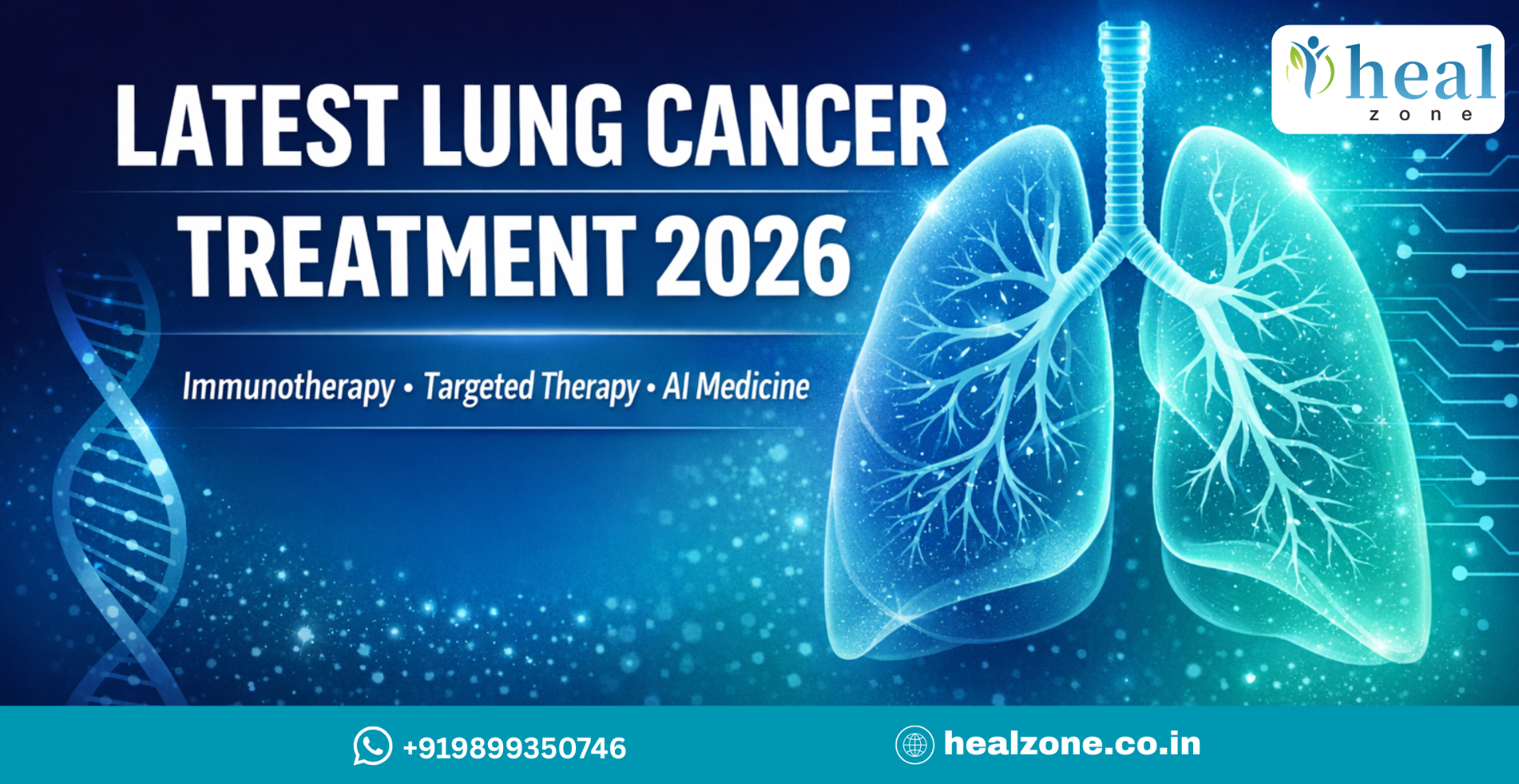
Lung cancer remains one of the most common and serious cancers worldwide, accounting for a large proportion of cancer-related deaths each year. Despite this, the treatment landscape for lung cancer has transformed dramatically over the past decade due to rapid progress in precision medicine, immunotherapy, targeted drugs, and advanced radiation technologies.
In 2025–2026, multiple new drug approvals, molecular-targeted therapies, antibody-drug conjugates, and bispecific immune therapies have further improved survival and quality of life for patients with both non-small cell lung cancer (NSCLC) and small cell lung cancer (SCLC).
This guide explains the latest lung cancer treatment options in 2026, including:
New FDA-approved therapies
Breakthrough immunotherapies
Targeted molecular treatments
Precision diagnostics and AI innovations
Emerging clinical trials
Why India is becoming a global destination for advanced lung cancer care
Major Breakthroughs in Lung Cancer Treatment (2025–2026)
1. Rapid Expansion of Precision Medicine
Precision oncology now guides most lung cancer treatment decisions.
In 2025 alone, multiple FDA approvals expanded therapies targeting:
- MET
- TROP-2
- EGFR exon 20
- ROS1
- HER2 mutations
These advances highlight the shift toward biomarker-driven treatment selection, improving outcomes for specific genetic subtypes of NSCLC.
2. New Targeted Therapies for NSCLC
ROS1-Positive Lung Cancer Treatment
A next-generation ROS1 inhibitor received regulatory approval for advanced NSCLC, offering strong efficacy in clinical trials and becoming a new option for this rare genetic subtype affecting about 2% of NSCLC patients.
Some modern ROS1-targeted drugs are also designed to:
- Cross the blood–brain barrier
- Control brain metastases
- Improve long-term disease control
HER2-Mutated Lung Cancer Therapies
Two oral HER2 inhibitors gained approval for previously treated advanced NSCLC with HER2 mutations, a group representing ~2–4% of patients.
These drugs:
- Specifically target tumor-driving mutations
- Avoid inhibition of normal EGFR receptors
- Potentially reduce severe side effects compared with older therapies
Antibody-Drug Conjugates (ADCs)
ADCs are among the most promising innovations in lung cancer therapy.
They work like guided missiles, delivering chemotherapy directly into cancer cells while sparing healthy tissue.
Recent approvals include ADCs targeting:
- c-Met overexpression
- EGFR-mutated disease
- TROP-2 proteins
These therapies show improved response rates compared with traditional chemotherapy, especially in previously treated NSCLC.
3. Immunotherapy Revolution Continues
Immunotherapy remains central to lung cancer care in 2026.
Bispecific T-Cell Engagers for SCLC
A DLL3-targeted bispecific therapy gained full approval for patients with extensive-stage SCLC who progressed after chemotherapy.
Clinical trials demonstrated:
- Improved overall survival
- Better progression-free survival
- A major advance for relapsed SCLC after years of limited progress
Maintenance Combination Immunotherapy
A newly approved combination maintenance therapy for extensive-stage SCLC:
- Reduced disease progression by ~46%
- Reduced risk of death by ~27%
- Represents the first first-line maintenance combination for this aggressive cancer type
Faster and Easier Immunotherapy Delivery
Innovations in drug delivery are also improving patient experience.
A new five-minute injectable formulation of immunotherapy can treat multiple cancers, including lung cancer, drastically reducing treatment time compared with long IV infusions.
4. Advances in Early-Stage and Surgical Treatment
Recent approvals expanded neoadjuvant and adjuvant immunotherapy for surgically removable NSCLC:
- Immunotherapy combined with chemotherapy before surgery
- Continued immunotherapy after surgery
This perioperative approach significantly improves outcomes for eligible patients.
Cutting-Edge Technologies Transforming Diagnosis & Treatment
AI-Driven Cancer Diagnosis
New AI-based imaging and pathology techniques can:
- Identify NSCLC subtypes with extremely high accuracy
- Generate virtual immunohistochemical staining
- Speed up diagnosis without traditional tissue processing
These tools may significantly accelerate treatment decisions in the near future.
AI Prediction of Immunotherapy Response
Advanced deep-learning models can now:
- Predict treatment response
- Estimate survival outcomes
- Integrate imaging, biomarkers, and clinical data
This may help doctors personalize therapy more precisely in upcoming years.
Advanced Radiation & Proton Therapy
Modern proton-beam planning techniques can:
- Maintain accurate dose delivery despite breathing motion
- Improve treatment precision for lung tumors
- Support hypofractionated therapy with fewer sessions
These advances enhance safety and effectiveness of radiation therapy.
Emerging Therapies and Research Directions for 2026+
Triple-Action Targeted Antibody Treatments
New multi-pathway targeted antibodies are showing:
- Tumor shrinkage in a majority of patients
- Improved quality of life
- Manageable side-effect profiles
Such therapies may soon expand into lung cancer treatment.
Next-Generation EGFR Inhibitors in Trials
New third-generation EGFR inhibitors are under Phase III trials targeting resistance mutations like T790M, with improved tolerability compared to earlier drugs.
Novel Immune-Stimulating Therapies
Some regions have already granted early approvals for new immune-activating biologics combined with checkpoint inhibitors for metastatic NSCLC after standard therapy failure, signaling future global expansion.
Personalized Treatment Planning in 2026
Modern lung cancer care now depends on:
Molecular Testing
- EGFR
- ALK
- ROS1
- MET
- HER2
- NRG1
These biomarkers determine targeted therapy eligibility and improve survival outcomes.
Multidisciplinary Care
Best outcomes are achieved through:
- Medical oncologists
- Thoracic surgeons
- Radiation oncologists
- Molecular pathologists
- Immunotherapy specialists
Why International Patients Choose India for Lung Cancer Treatment
India has emerged as a leading medical tourism destination because of:
Advanced Technology
- Robotic surgery
- Proton therapy
- Molecular diagnostics
- Immunotherapy access
Experienced Cancer Specialists
- Internationally trained oncologists
- High-volume cancer centers
Affordable Treatment
-
Costs often 60–80% lower than Western countries
Minimal Waiting Time
Faster diagnosis and treatment start
Cost of Latest Lung Cancer Treatments in India (2026)
|
Treatment Type |
Estimated Cost (USD) |
|
Targeted therapy |
$1,500 – $4,000/month |
|
Immunotherapy |
$2,000 – $6,000/cycle |
|
Lung cancer surgery |
$4,000 – $8,000 |
|
Proton therapy |
$12,000 – $25,000 |
|
Full treatment package |
$8,000 – $35,000 |
(Costs vary by hospital, stage, and treatment plan.)
Survival Improvements with Modern Treatments
Thanks to new therapies:
- Many advanced NSCLC patients now live several years
- Some achieve long-term remission
SCLC survival is gradually improving with bispecific and combination immunotherapy
How Healzone Helps International Lung Cancer Patients
Healzone provides:
- Access to top cancer hospitals in India
- Doctor consultations & treatment planning
- Visa, travel, and accommodation support
- Transparent cost estimates
End-to-end patient assistance
Conclusion
The year 2026 marks a new era in lung cancer treatment.
Breakthroughs in:
- Targeted therapy
- Immunotherapy
- Bispecific antibodies
- AI-guided precision medicine
- Advanced radiation technology
are transforming lung cancer from a fatal disease into a treatable and often manageable condition.
For international patients, India—supported by Healzone—offers world-class treatment at affordable costs, making advanced lung cancer care accessible to people across the globe.
Contact us
Written by

B.Sc. & M.Sc. in Medical Imaging Technology
Frequently Asked Questions
In 2026, lung cancer treatment includes targeted therapy, immunotherapy, antibody-drug conjugates, bispecific immune therapies, advanced radiation therapy, robotic surgery, and precision medicine-based treatment planning. These modern approaches help improve survival rates, reduce side effects, and offer more personalized care compared to traditional chemotherapy alone.
Early-stage lung cancer can often be completely cured with surgery, radiation therapy, and adjuvant treatments.
For advanced lung cancer, modern therapies are helping many patients live longer with good quality of life, and in some cases achieve long-term remission.
Targeted therapy uses special medicines that attack specific genetic mutations in cancer cells without harming most normal cells.
These treatments are recommended only after molecular testing confirms the presence of certain mutations, making therapy more precise and effective.
Chemotherapy directly kills rapidly dividing cells, including some healthy cells.
Immunotherapy, on the other hand, activates the body’s immune system to recognize and destroy cancer cells, often causing fewer long-term side effects and better survival outcomes in suitable patients.
Precision medicine means customizing treatment based on a patient’s tumor genetics, biomarkers, and overall health condition.
Doctors use molecular testing and advanced diagnostics to choose the most effective therapy for each individual patient.
Latest Blogs
Reviews
I am Fadel Abu Muhammad from Tal Afar, Iraq My father had a brain tumor. We traveled to India to Accord Specialty Hospital, New Delhi, through a resident professor, Muhammad, Dr. Vikram, who called for a laparoscopic tumor removal operation. Thank God I thank the translator, the doctor, and all the hospital staff.
Posted On

I am Muhammad Reda from Baghdad, Iraq I was suffering from weakness in my left hand. I underwent tests and it turned out that I had a brain tumor. The translator, Muqeem Muhammad, contacted us and we traveled to India. I had a neuronavigation procedure performed by Dr. Sandeep Vashya Praise be to God, the operation was completed successfully on the computer At Fortis Hospital New Delhi I thank the translator and the doctor
Posted On
All our gratitude and appreciation to the wonderful translator Mohammed Muqeem, who was truly a great support and companion during our journey for my mother’s treatment in India. He was extremely helpful, deeply understanding of all our needs, patient, and dedicated in his work, which eased a lot of the hardship and challenges we faced being away from home. His presence with us was not just about translating words but about offering real human support in every situation and every moment. May God bless him and reward him greatly for all he has done for us.
Posted On
I'm Emad Mohammed Khadir from Iraq. I was suffering from cirrhosis and liver cancer. I came to Fortis Hospital in India to see Dr. Ankur Bahil, a consultant oncologist, with the help of our translator, resident professor Mohammed Al Hindi. Thank God, we received our chemotherapy doses. The doctor and all the hospital staff were very kind and helpful. May God bless them all. Thank you.
Posted On
I am Redha Fadel from Nasiriyah, Iraq. I had a bone tumor, osteosarcoma. I traveled to India to see Dr. Ankur, a cancer specialist at Fortis Hospital, with the help of Hill Zone Medical Tourism Company, Professor Muqeem Muhammad Al Hindi. I thank you for your humanity and services.
Posted On
Peace be upon you. I am from Iraq. My brother is suffering from a tumor in his left thigh (osteosarcoma). We came to Al-Nahda for treatment. We stayed at Fortis Hospital for two months. We are now going to Iraq and will return to India to complete the treatment and the joint replacement surgery. I would like to thank the polite Indian translator, Muqeem Mohammed Al-Hindi. He was our brother before he was a translator and he helped us a lot with my brother's illness. Thank you, Muqeem. Thank you, Fortis Hospital. Thank you, Dr. Ankur.
Posted On
Peace be upon you, I'm from Iraq. My name is Majid Mazhar Kazim. My brother was suffering from tumors, so we contacted a resident professor, Muhammad Al-Hindi, and we sent him medical reports. He received us from the airport in New Delhi. I highly recommend him to Iraqi patients. He is helpful and well-mannered. He didn't hold back on us and didn't leave us alone from the first day until the last. He also took us to the airport. I thank them all.
Posted On
I am Mohammed Kazim from Iraq, from Babylon. My brother Mushtaq was suffering from meningitis. We came to India to Fortis Hospital through our resident professor, Mohammed, the director of Hill Zone Medical Services. I thank them for their kind treatment and translation. It was an enjoyable and fruitful trip. Praise be to God.
Posted On
I am from iraq tilafar, i came to India for my treatment an immune disease, i am thankful to Mr Muqeem and hospital staff, Marego Asia Hospital
Posted On
I am from Iraq. My son was suffering from Hirayama disease. I called Heal Zone, and they arranged our treatment journey. Now my son is in good health, and his finger movement has come back.
Posted On
