

Contact us
AI-Assisted Knee Replacement Surgery in India | Cost, Benefits & Top Hospitals | HealZone
By Shaivana Bano
19 July 2026
- AI-Assisted Knee Replacement Surgery in India: Everything International Patients Need to Know
- What is AI-Assisted Knee Replacement Surgery?
- Why is AI Changing Knee Replacement Surgery?
- How Does AI-Assisted Knee Replacement Work?
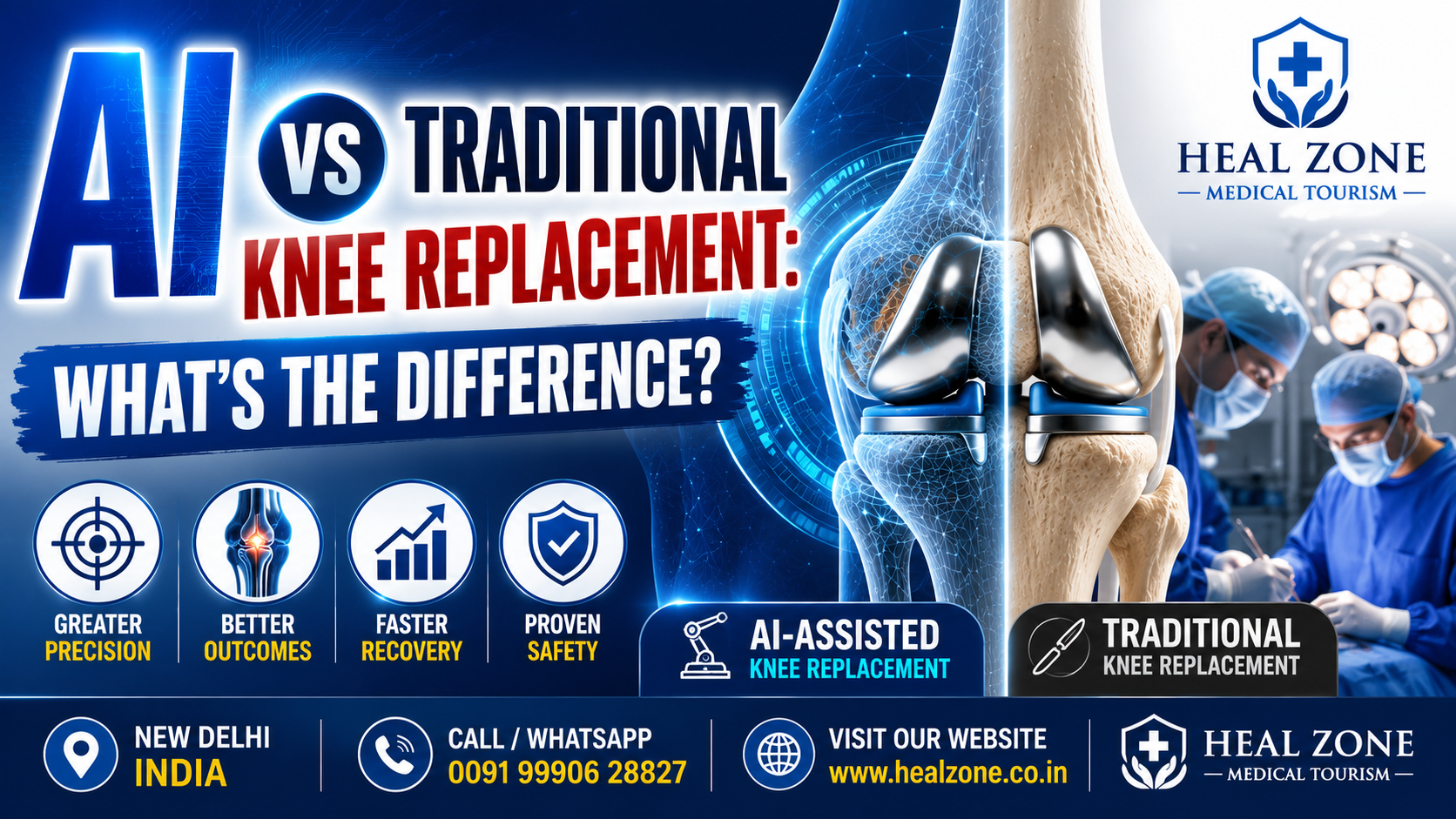
- AI-Assisted Knee Replacement vs Traditional Knee Replacement
- AI-Assisted Knee Replacement vs Robotic Knee Replacement
- Benefits of AI-Assisted Knee Replacement Surgery
- Who is a Candidate for AI-Assisted Knee Replacement?
- Conditions Treated with AI-Assisted Knee Replacement
- Diagnosis Before AI-Assisted Knee Replacement Surgery
- Preparing for AI-Assisted Knee Replacement Surgery
- Step-by-Step AI-Assisted Knee Replacement Surgery Procedure
- Types of AI and Robotic Knee Replacement Systems
- Recovery After AI-Assisted Knee Replacement Surgery
- Rehabilitation and Physiotherapy After AI-Assisted Knee Replacement Surgery
- Risks and Complications in AI-Assisted Knee Replacement Surgery
- Success Rate of AI-Assisted Knee Replacement Surgery
- Cost of AI-Assisted Knee Replacement Surgery in India
- Estimated Cost of AI-Assisted Knee Replacement in India
- Cost Comparison: India vs Other Countries
- Factors Affecting the Cost of AI-Assisted Knee Replacement Surgery
- Best Hospitals in India for AI-Assisted Knee Replacement Surgery
- Best Orthopedic Surgeons in India for AI-Assisted Knee Replacement
- Why International Patients Choose India for AI-Assisted Knee Replacement Surgery
- Why Choose AI-Assisted Knee Replacement Over Conventional Surgery?
- Life After AI-Assisted Knee Replacement
- Travel Guide for International Patients Coming to India
- Estimated Duration of Stay in India After AI-Assisted Knee Replacement Surgery
- Why Choose HealZone for AI-Assisted Knee Replacement in India?
- Conclusion
- Contact HealZone Today
AI-Assisted Knee Replacement Surgery in India: Everything International Patients Need to Know
Living with chronic knee pain can significantly affect your quality of life, making even simple daily activities such as walking, climbing stairs, or standing difficult. For patients suffering from severe arthritis, joint damage, or knee deformities, knee replacement surgery provides the best opportunity to regain mobility and live pain-free. Today, orthopedic surgery has entered a new era with the introduction of Artificial Intelligence (AI)-assisted knee replacement surgery. By combining advanced imaging, computer algorithms, and intelligent surgical planning, AI helps orthopedic surgeons perform highly personalized and precise joint replacement procedures.
India has rapidly become one of the world's leading destinations for AI-assisted knee replacement surgery. International patients choose India because of its internationally trained orthopedic surgeons, state-of-the-art hospitals, advanced AI-enabled surgical systems, and treatment costs that are substantially lower than those in many developed countries.
At HealZone, we help international patients connect with India's leading orthopedic specialists and hospitals. From reviewing medical reports and arranging online consultations to visa assistance, accommodation, airport transfers, and post-treatment support, we provide complete medical travel coordination for a smooth and stress-free experience.
What is AI-Assisted Knee Replacement Surgery?
AI-assisted knee replacement surgery is an advanced orthopedic procedure that utilizes artificial intelligence, computer-assisted planning, and intelligent surgical guidance to enhance the accuracy of knee replacement operations. Unlike traditional knee replacement surgery, AI technology analyzes the patient's unique anatomy prior to the procedure and generates a personalized surgical plan. During the surgery, the system provides real-time guidance to help the surgeon position the implant more accurately and achieve optimal joint alignment.
Some AI-assisted systems also collect and analyze data during the surgery, enabling surgeons to make precise adjustments that can improve implant performance and long-term outcomes. This technology is designed to support the surgeon rather than replace them, focusing on enhancing precision and reducing variability throughout the procedure.
Why is AI Changing Knee Replacement Surgery?
Artificial Intelligence is transforming orthopedic surgery by enabling greater precision and personalization. Every patient's knee anatomy is different, and AI helps surgeons tailor the procedure to individual needs rather than relying solely on standard measurements.
AI-assisted surgery offers several advantages:
- Personalized surgical planning
- Improved implant positioning
- Better knee alignment
- Enhanced surgical precision
- Reduced damage to surrounding tissues
- More balanced joint movement
- Potentially faster recovery
- Improved patient satisfaction
These advantages help orthopedic surgeons deliver more predictable outcomes while preserving healthy tissues and optimizing implant positioning.
How Does AI-Assisted Knee Replacement Work?
Before surgery begins, advanced imaging studies such as X-rays, CT scans, or MRI scans are used to create a three-dimensional model of the patient's knee. Artificial intelligence then analyzes this information to develop a customized surgical strategy. During the procedure, the AI platform continuously assists the surgeon by providing real-time guidance regarding implant placement, alignment, and bone preparation.
The overall process generally includes:
- Pre-operative imaging
- AI-generated surgical planning
- Real-time navigation
- Implant alignment guidance
- Continuous accuracy monitoring
- Final implant verification
By combining advanced software with the expertise of experienced orthopedic surgeons, AI-assisted systems help improve surgical consistency while maintaining complete surgeon control.
AI-Assisted Knee Replacement vs Traditional Knee Replacement
Both traditional and AI-assisted knee replacement surgeries aim to relieve pain and restore mobility. However, AI technology introduces an additional level of precision that helps surgeons customize the procedure according to the patient's anatomy.
| Feature | Traditional Knee Replacement | AI-Assisted Knee Replacement |
|---|---|---|
| Surgical Planning | Standard measurements | Personalized AI-based planning |
| Implant Positioning | Manual | AI-guided precision |
| Bone Preparation | Conventional instruments | Computer-guided accuracy |
| Joint Alignment | Surgeon experience | AI-assisted optimization |
| Surgical Precision | Excellent | Higher precision |
| Soft Tissue Protection | Standard | Improved accuracy |
| Recovery | Standard | faster |
| Implant Longevity | Excellent | Improve long-term performance |
Both procedures are effective. However, AI-assisted surgery provides additional guidance that may improve implant alignment, knee function, and patient satisfaction in appropriately selected cases.
AI-Assisted Knee Replacement vs Robotic Knee Replacement
Many patients confuse AI-assisted surgery with robotic surgery. Although they are closely related, they are not exactly the same.
AI technology focuses on intelligent planning and decision support, while robotic systems help execute the surgical plan with high precision.
| Feature | AI-Assisted Surgery | Robotic-Assisted Surgery |
|---|---|---|
| Personalized Planning | Yes | Yes |
| Artificial Intelligence | Yes | Limited (system-dependent) |
| Robotic Arm | Optional | Yes |
| Real-Time Guidance | Yes | Yes |
| Surgeon Control | Complete | Complete |
| Precision | Very High | Very High |
| Customized Implant Placement | Yes | Yes |
Many modern knee replacement platforms combine artificial intelligence with robotic assistance, providing surgeons with the benefits of both technologies.
Benefits of AI-Assisted Knee Replacement Surgery
AI-assisted knee replacement offers numerous clinical advantages that can contribute to better surgical accuracy and patient outcomes. While results vary depending on the individual's condition and overall health, this technology has become an important advancement in orthopedic care.
Some of the major benefits include:
- Greater implant accuracy
- Personalized treatment planning
- Better joint alignment
- Improved knee stability
- Smaller margin of error
- Reduced blood loss
- Less damage to healthy tissues
- Better ligament balancing
- Faster rehabilitation
- Shorter hospital stay
- Reduced post-operative pain
- Improved long-term implant performance
These benefits have made AI-assisted knee replacement an increasingly preferred option for patients seeking advanced orthopedic care and long-lasting results.
Who is a Candidate for AI-Assisted Knee Replacement?
Not every patient with knee pain requires knee replacement surgery. AI-assisted procedures are generally recommended for individuals with severe joint damage that has not responded to conservative treatments.
Your orthopedic surgeon will carefully evaluate your symptoms, imaging studies, medical history, and lifestyle before recommending surgery.
Patients who may benefit include:
- Severe osteoarthritis
- Rheumatoid arthritis
- Post-traumatic arthritis
- Advanced cartilage damage
- Knee deformity
- Persistent knee pain
- Difficulty walking
- Joint stiffness
- Failed previous knee surgery
- Poor response to medications or physiotherapy
Early consultation with an experienced orthopedic specialist can help determine whether AI-assisted knee replacement is the most suitable treatment option.
Conditions Treated with AI-Assisted Knee Replacement
AI-assisted technology is used to treat a variety of degenerative and structural knee conditions that significantly impact mobility and quality of life.
Common conditions include:
- Osteoarthritis
- Rheumatoid arthritis
- Post-traumatic arthritis
- Avascular necrosis
- Severe cartilage loss
- Knee deformity
- Degenerative joint disease
- Failed partial knee replacement
- Revision knee replacement
- Chronic knee instability
With precise planning and implant positioning, AI-assisted surgery can help restore joint function while improving overall patient satisfaction.
Diagnosis Before AI-Assisted Knee Replacement Surgery
Accurate diagnosis is essential before planning knee replacement surgery. A comprehensive evaluation helps the orthopedic surgeon understand the extent of joint damage and determine whether AI-assisted surgery is appropriate.
The diagnostic process generally includes:
- Physical examination
- Medical history review
- Digital X-rays
- MRI scan (when required)
- CT scan (selected cases)
- Blood investigations
- Joint alignment assessment
- Mobility evaluation
- Cardiac fitness assessment
- Anesthesia evaluation
A thorough pre-operative assessment allows the surgical team to develop a personalized treatment plan and minimize potential risks during surgery.
Preparing for AI-Assisted Knee Replacement Surgery
Proper preparation plays an important role in ensuring a successful operation and smooth recovery. Patients are encouraged to follow their surgeon's instructions carefully in the weeks leading up to surgery.
Preparation typically includes:
- Completing all medical investigations
- Optimizing existing medical conditions
- Reviewing current medications
- Stopping certain blood-thinning medicines (only if advised)
- Performing pre-operative physiotherapy exercises
- Maintaining a healthy diet
- Planning post-operative support
- Arranging travel and accommodation (for international patients)
Good preparation not only improves surgical outcomes but also helps patients recover more confidently after the procedure.
Step-by-Step AI-Assisted Knee Replacement Surgery Procedure
AI-assisted knee replacement surgery follows a carefully planned process designed to maximize precision, improve implant positioning, and restore normal knee function. While every patient's treatment plan is personalized, the overall procedure follows a structured sequence.
Understanding each stage helps international patients prepare confidently for surgery and know what to expect during their hospital stay.
The procedure generally includes the following steps:
1. Admission and Pre-operative Preparation
Patients are admitted one day before or on the day of surgery. The medical team performs final evaluations, including blood tests, ECG, anesthesia assessment, and confirmation of the AI-generated surgical plan.
2. Administration of Anesthesia
The surgery is usually performed under spinal anesthesia, although general anesthesia may be recommended in certain cases depending on the patient's health.
3. AI-Based Surgical Planning
Before the first incision, the AI platform reviews the patient's anatomical data collected from X-rays, CT scans, or MRI scans. The software generates a personalized surgical roadmap that guides implant placement and alignment.
4. Precise Bone Preparation
Using AI guidance and advanced navigation systems, the orthopedic surgeon prepares the damaged bone while preserving as much healthy tissue as possible.
5. Implant Positioning
The artificial knee implant is positioned according to the AI-generated plan to achieve optimal alignment, stability, and joint movement.
6. Ligament Balancing
The surgeon evaluates ligament tension and makes fine adjustments to ensure smooth knee movement and long-term stability.
7. Final Verification
Before closing the incision, the AI system verifies implant alignment, knee motion, and overall positioning to ensure optimal results.
8. Closure
The incision is closed using sutures or surgical staples, and a sterile dressing is applied.
Patients are then transferred to the recovery room, where they are closely monitored before beginning rehabilitation.
The combination of advanced technology and experienced orthopedic expertise allows for a highly personalized procedure that aims to improve long-term outcomes.
Types of AI and Robotic Knee Replacement Systems
Several advanced technologies are currently used in leading orthopedic centers across India. Although each platform has unique features, they all aim to improve surgical precision and patient outcomes.
Some of the most widely used systems include:
MAKO SmartRobotics™
- CT-based surgical planning
- Highly accurate implant positioning
- Robotic arm assistance
- Real-time surgical guidance
ROSA® Knee System
- Personalized implant alignment
- Real-time data analysis
- Soft tissue balancing
- Intelligent navigation
CORI Surgical System
- Image-free navigation
- Digital knee mapping
- Personalized surgical planning
- Compact robotic technology
VELYS™ Robotic-Assisted Solution
- AI-supported workflow
- Precision bone preparation
- Enhanced implant positioning
- Data-driven surgical decisions
NAVIO Surgical System
- Image-free technology
- Real-time mapping
- Customized implant alignment
- Improved surgical accuracy
Each platform offers unique advantages, and the choice depends on the patient's condition, implant selection, and the surgeon's expertise. Your orthopedic specialist will recommend the most appropriate technology based on your individual needs.
Recovery After AI-Assisted Knee Replacement Surgery
Recovery is a gradual process that involves pain management, physiotherapy, and lifestyle adjustments. AI-assisted surgery may support a smoother recovery by improving implant alignment and reducing unnecessary soft tissue damage, but rehabilitation remains essential for achieving the best results.
A typical recovery timeline includes:
| Recovery Stage | Expected Timeline |
|---|---|
| Standing with support | Same day or next day |
| Walking with walker | 1–2 days |
| Hospital discharge | 3–5 days |
| Climbing stairs | 2–4 weeks |
| Driving | 4–6 weeks |
| Returning to office work | 4–8 weeks |
| Light exercise | 6–8 weeks |
| Full recovery | 3–6 months |
Following your physiotherapy program and surgeon's advice is critical to restoring strength, flexibility, and long-term knee function.
Rehabilitation and Physiotherapy After AI-Assisted Knee Replacement Surgery
Rehabilitation is one of the most important components of successful knee replacement surgery. Even with advanced AI technology, consistent physiotherapy is essential for achieving the best functional outcome.
A structured rehabilitation program typically includes:
- Range-of-motion exercises
- Muscle strengthening
- Walking practice
- Balance training
- Stair-climbing exercises
- Gait correction
- Flexibility exercises
- Home exercise program
Regular physiotherapy improves mobility, reduces stiffness, and helps patients return to normal daily activities more quickly.
Risks and Complications in AI-Assisted Knee Replacement Surgery
AI-assisted knee replacement is considered a safe and effective procedure when performed by experienced orthopedic surgeons. However, like all major surgeries, it carries certain risks.
Possible complications include:
- Infection
- Blood clots
- Bleeding
- Implant loosening
- Nerve injury
- Joint stiffness
- Persistent pain
- Swelling
- Implant wear over time
- Need for revision surgery
Careful surgical planning, experienced medical teams, and adherence to post-operative instructions help reduce the likelihood of these complications.
Success Rate of AI-Assisted Knee Replacement Surgery
AI-assisted knee replacement has demonstrated excellent clinical outcomes when combined with experienced surgical care and appropriate rehabilitation.
Many patients experience:
- Significant pain relief
- Improved walking ability
- Better joint function
- Increased implant accuracy
- Enhanced quality of life
- High patient satisfaction
Studies have shown that modern knee replacement surgery generally achieves excellent long-term outcomes, with many implants lasting 15–20 years or longer when patients maintain a healthy lifestyle and follow their surgeon's recommendations.
Cost of AI-Assisted Knee Replacement Surgery in India
One of the biggest reasons international patients choose India is the combination of advanced orthopedic technology and affordable treatment costs. AI-assisted knee replacement in India is significantly less expensive than in many Western countries while maintaining high standards of care.
The estimated cost usually includes:
- Surgeon fees
- Hospital charges
- Operation theatre expenses
- AI or robotic surgical technology
- Standard knee implant
- Anesthesia
- Nursing care
- Hospital stay
- Routine medications
- Basic investigations
Estimated Cost of AI-Assisted Knee Replacement in India
| Procedure | Estimated Cost (USD) | Estimated Cost (INR) |
|---|---|---|
| Single Knee Replacement | $4,500–5,500 | 4.7–7.3 lakh |
| Bilateral Knee Replacement | $6,500–10,000 | 8.1–10.9 lakh |
| Revision Knee Replacement | $7,000–10,500 | 6.0–10.7 lakh |
Note: Costs vary depending on the hospital, surgeon, implant brand, city, room category, and individual medical requirements. A personalized quotation is recommended before treatment.
Cost Comparison: India vs Other Countries
For international patients, India offers substantial cost savings without compromising access to experienced specialists and advanced surgical technologies.
| Country | Estimated Cost (USD) |
|---|---|
| India | $5,500–8,500 |
| USA | $40,000–70,000 |
| UK | $18,000–30,000 |
| UAE | $20,000–35,000 |
| Canada | $22,000–35,000 |
| Australia | $25,000–40,000 |
Many patients save 50–80% on treatment costs by choosing India, even after accounting for travel and accommodation expenses.
Factors Affecting the Cost of AI-Assisted Knee Replacement Surgery
The final cost of AI-assisted knee replacement surgery can vary depending on several clinical and non-clinical factors.
These include:
- Type of knee implant
- AI or robotic platform used
- Hospital accreditation
- Surgeon's experience
- Single or bilateral procedure
- Revision surgery
- Medical condition of the patient
- Length of hospital stay
- Rehabilitation requirements
- City where treatment is performed
Discussing these factors during your consultation helps you understand the expected treatment expenses and plan your medical journey effectively.
Best Hospitals in India for AI-Assisted Knee Replacement Surgery
India is home to numerous internationally recognized hospitals equipped with advanced AI and robotic orthopedic technologies. These centers offer comprehensive care for both domestic and international patients.
Some of the leading hospitals include:
- Apollo Hospitals, New Delhi
- Medanta – The Medicity, Gurugram
- Fortis Memorial Research Institute, Gurugram
- Max Super Speciality Hospital, Saket, New Delhi
- Artemis Hospital, Gurugram
- Manipal Hospitals, Bengaluru
- BLK-Max Super Speciality Hospital, New Delhi
These hospitals feature modern operating theaters, dedicated rehabilitation departments, and experienced international patient services to support overseas visitors throughout their treatment journey.
Best Orthopedic Surgeons in India for AI-Assisted Knee Replacement
Choosing an experienced orthopedic surgeon is one of the most important factors influencing surgical success. India has many highly qualified specialists with extensive expertise in AI-assisted and robotic joint replacement.
Some of the renowned orthopedic surgeons include:
- Dr. Ashok Rajgopal
- Dr. IPS Oberoi
- Dr Hemant Sharma
- Dr. Yash Gulati
- Dr. Ramneek Mahajan
- Dr. Subhash Jangid
- Dr. Sanjay Desai
- Dr. Aashish Chaudhry
These specialists are known for performing complex knee replacement procedures and treating patients from around the world using advanced surgical technologies.
Why International Patients Choose India for AI-Assisted Knee Replacement Surgery
India has become one of the most trusted destinations for orthopedic care, attracting thousands of international patients each year. The country's healthcare system combines experienced orthopedic surgeons, advanced AI-assisted surgical technologies, internationally accredited hospitals, and affordable treatment costs, making it an excellent choice for knee replacement surgery.
Patients from Africa, the Middle East, Central Asia, Southeast Asia, Europe, and North America increasingly choose India because they can receive world-class treatment without the long waiting periods often experienced in their home countries.
Some of the key reasons include:
- Internationally trained orthopedic surgeons
- AI-assisted and robotic surgical technologies
- Modern JCI and NABH-accredited hospitals
- Affordable treatment packages
- Short waiting times
- Personalized treatment plans
- English-speaking medical professionals
- Dedicated international patient departments
- Advanced rehabilitation facilities
- Excellent success rates
India's reputation for high-quality healthcare continues to grow, offering international patients access to cutting-edge orthopedic treatments while significantly reducing overall medical expenses.
Why Choose AI-Assisted Knee Replacement Over Conventional Surgery?
Advancements in artificial intelligence have transformed the way orthopedic surgeons perform knee replacement procedures. While conventional surgery remains highly effective, AI-assisted surgery provides an additional layer of precision that may improve implant positioning and overall surgical planning.
Patients often choose AI-assisted surgery because it offers:
- Personalized implant positioning
- Better restoration of natural knee alignment
- Greater surgical accuracy
- Enhanced soft tissue preservation
- Improved ligament balancing
- Reduced margin of surgical error
- More predictable outcomes
- Potentially improved implant longevity
- Better patient satisfaction
It is important to remember that successful outcomes depend not only on technology but also on the surgeon's expertise, proper rehabilitation, and patient commitment to recovery.
Life After AI-Assisted Knee Replacement
Most patients experience significant improvement in pain, mobility, and quality of life following successful knee replacement surgery. Recovery is gradual, and following medical advice plays a vital role in achieving the best possible outcome.
After rehabilitation, many patients can return to activities such as:
- Walking comfortably
- Climbing stairs
- Driving (with medical clearance)
- Gardening
- Traveling
- Light hiking
- Swimming
- Cycling
- Playing golf
- Performing daily household activities
Maintaining a healthy weight, staying physically active, and attending regular follow-up appointments can help maximize the lifespan of the knee implant.
Travel Guide for International Patients Coming to India
Planning your medical trip carefully ensures a smoother experience from arrival to recovery. HealZone assists international patients at every stage of their journey.
Before traveling, make sure you have:
- A valid passport
- Medical Visa (if required)
- Hospital appointment confirmation
- Medical reports
- Imaging studies (X-rays, MRI, CT scans)
- Current medication list
- Insurance documents (if applicable)
- Travel insurance
- Sufficient prescribed medications
- Emergency contact information
Preparing these documents in advance helps avoid delays and allows your medical team to begin treatment promptly.
Estimated Duration of Stay in India After AI-Assisted Knee Replacement Surgery
International patients should plan adequate time for surgery, rehabilitation, and follow-up before returning home.
| Stage | Recommended Duration |
|---|---|
| Initial Consultation | 1 Day |
| Pre-operative Evaluation | 1 Day |
| Surgery | 1 Day |
| Hospital Stay | 3–5 Days |
| Rehabilitation | 10–14 Days |
| Follow-up Before Departure | 1 Days |
| Total Recommended Stay | 2–3 Weeks |
The exact duration may vary depending on the patient's recovery and the surgeon's recommendations.
Why Choose HealZone for AI-Assisted Knee Replacement in India?
Choosing the right medical travel partner is just as important as selecting the right hospital. HealZone serves as your dedicated healthcare facilitator, helping you navigate every step of your treatment journey in India.
We work with leading orthopedic hospitals and experienced surgeons to provide personalized, transparent, and patient-centered services for international visitors.
Our services include:
- Free medical report review
- Expert opinion from leading orthopedic surgeons
- Hospital comparison based on your needs
- Personalized treatment cost estimates
- Appointment scheduling
- Medical visa assistance
- Airport pickup and drop-off
- Hotel and accommodation arrangements
- Language interpreter services
- Dedicated international patient coordinator
- Assistance with insurance documentation
- Post-treatment follow-up support
Our goal is to make your medical journey safe, comfortable, and stress-free while helping you access high-quality orthopedic care in India.
Conclusion
AI-assisted knee replacement surgery represents a significant advancement in orthopedic care, combining artificial intelligence with the expertise of skilled surgeons to deliver personalized, precise treatment. While the technology enhances surgical planning and implant positioning, successful outcomes continue to depend on careful patient evaluation, experienced surgical teams, and dedicated rehabilitation.
India has emerged as a leading destination for AI-assisted knee replacement by offering advanced medical technology, internationally trained orthopedic specialists, modern hospitals, and cost-effective treatment options. These advantages make it an attractive choice for international patients seeking high-quality care without compromising on safety or outcomes.
If you are considering AI-assisted knee replacement surgery in India, HealZone is here to support you throughout your medical journey. From reviewing your medical records and recommending suitable hospitals to coordinating consultations, travel, accommodation, and follow-up care, our team is committed to helping you access trusted orthopedic treatment with confidence.
Contact HealZone Today
Get a Free Medical Opinion and Personalized Treatment Plan
- Free medical report review
- Estimated treatment cost
- Recommended hospitals and orthopedic specialists
- Medical visa assistance
- Complete support for international patients
Start your journey toward improved mobility and a better quality of life with expert guidance from HealZone.
Contact us
Written by

B.Sc. & M.Sc. in Medical Imaging Technology


Dr. Hemant Sharma
MBBS, DNB, MRCS, FRCS
Orthopedic and Joint Replacement Surgeon
26 Years of Experience

Dr. Subhash Jangid
MBBS, MS, DNB, MCh
Orthopedic and Joint Replacement Surgeon
26 years Years of Experience

Latest Blogs


Reviews
I am Fadel Abu Muhammad from Tal Afar, Iraq My father had a brain tumor. We traveled to India to Accord Specialty Hospital, New Delhi, through a resident professor, Muhammad, Dr. Vikram, who called for a laparoscopic tumor removal operation. Thank God I thank the translator, the doctor, and all the hospital staff.
Posted On

I am Muhammad Reda from Baghdad, Iraq I was suffering from weakness in my left hand. I underwent tests and it turned out that I had a brain tumor. The translator, Muqeem Muhammad, contacted us and we traveled to India. I had a neuronavigation procedure performed by Dr. Sandeep Vashya Praise be to God, the operation was completed successfully on the computer At Fortis Hospital New Delhi I thank the translator and the doctor
Posted On
All our gratitude and appreciation to the wonderful translator Mohammed Muqeem, who was truly a great support and companion during our journey for my mother’s treatment in India. He was extremely helpful, deeply understanding of all our needs, patient, and dedicated in his work, which eased a lot of the hardship and challenges we faced being away from home. His presence with us was not just about translating words but about offering real human support in every situation and every moment. May God bless him and reward him greatly for all he has done for us.
Posted On
I'm Emad Mohammed Khadir from Iraq. I was suffering from cirrhosis and liver cancer. I came to Fortis Hospital in India to see Dr. Ankur Bahil, a consultant oncologist, with the help of our translator, resident professor Mohammed Al Hindi. Thank God, we received our chemotherapy doses. The doctor and all the hospital staff were very kind and helpful. May God bless them all. Thank you.
Posted On
I am Redha Fadel from Nasiriyah, Iraq. I had a bone tumor, osteosarcoma. I traveled to India to see Dr. Ankur, a cancer specialist at Fortis Hospital, with the help of Hill Zone Medical Tourism Company, Professor Muqeem Muhammad Al Hindi. I thank you for your humanity and services.
Posted On
Peace be upon you. I am from Iraq. My brother is suffering from a tumor in his left thigh (osteosarcoma). We came to Al-Nahda for treatment. We stayed at Fortis Hospital for two months. We are now going to Iraq and will return to India to complete the treatment and the joint replacement surgery. I would like to thank the polite Indian translator, Muqeem Mohammed Al-Hindi. He was our brother before he was a translator and he helped us a lot with my brother's illness. Thank you, Muqeem. Thank you, Fortis Hospital. Thank you, Dr. Ankur.
Posted On
Peace be upon you, I'm from Iraq. My name is Majid Mazhar Kazim. My brother was suffering from tumors, so we contacted a resident professor, Muhammad Al-Hindi, and we sent him medical reports. He received us from the airport in New Delhi. I highly recommend him to Iraqi patients. He is helpful and well-mannered. He didn't hold back on us and didn't leave us alone from the first day until the last. He also took us to the airport. I thank them all.
Posted On
I am Mohammed Kazim from Iraq, from Babylon. My brother Mushtaq was suffering from meningitis. We came to India to Fortis Hospital through our resident professor, Mohammed, the director of Hill Zone Medical Services. I thank them for their kind treatment and translation. It was an enjoyable and fruitful trip. Praise be to God.
Posted On
I am from iraq tilafar, i came to India for my treatment an immune disease, i am thankful to Mr Muqeem and hospital staff, Marego Asia Hospital
Posted On
I am from Iraq. My son was suffering from Hirayama disease. I called Heal Zone, and they arranged our treatment journey. Now my son is in good health, and his finger movement has come back.
Posted On
