

Contact us
How to Choose the Best Radiation Oncologist in India | Expert Guide 2026
By Shaivana Bano
19 July 2026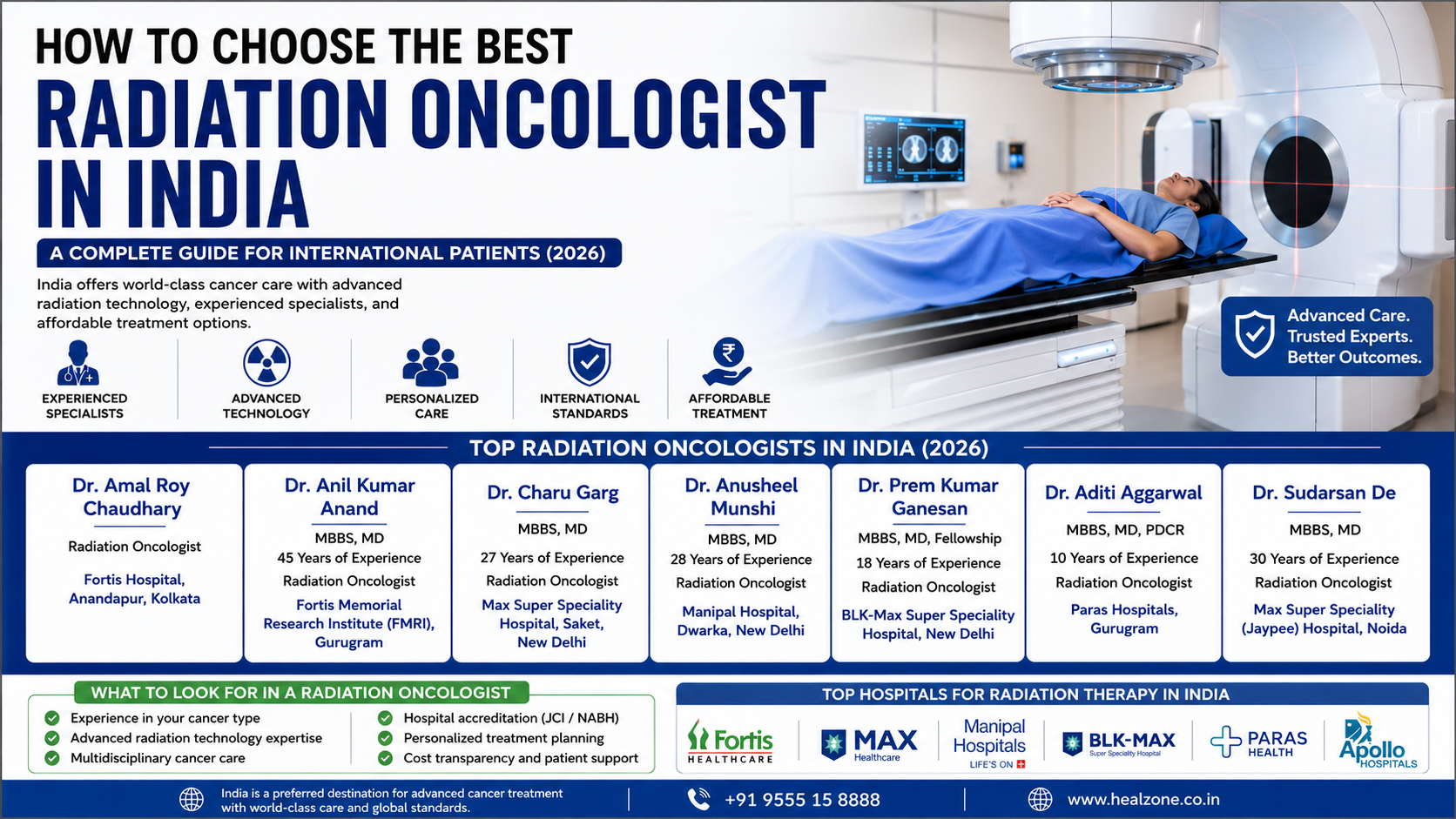
- How to Choose the Best Radiation Oncologist in India
- What Does a Radiation Oncologist Do?
- Why Choosing the Right Radiation Oncologist Matters
- Top Radiation Oncologists in India (2026)
- Choose a Doctor Who Specializes in Your Cancer Type
- Evaluate the Technology Available
- Look for Multidisciplinary Cancer Care
- Check Hospital Accreditation
- International Patient Services Matter
- Questions to Ask Before Choosing a Radiation Oncologist
- Compare Doctors Beyond Online Ratings
- Importance of Personalized Treatment Planning
- Why Advanced Radiation Technology Matters
- Understanding Treatment Costs in India
- Factors That Affect Radiation Therapy Costs in India
- Why International Patients Choose India for Radiation Therapy
- Red Flags to Watch For
- How HealZone Helps International Patients
- Conclusion
How to Choose the Best Radiation Oncologist in India
Receiving a cancer diagnosis is life-changing, and selecting the right radiation oncologist is one of the most important decisions a patient and their family will make. Radiation therapy plays a crucial role in treating many cancers, either as the primary treatment or alongside surgery, chemotherapy, immunotherapy, or targeted therapy.
India has become one of the world's leading destinations for advanced radiation oncology. Patients from the Middle East, Africa, Central Asia, Europe, and neighboring countries travel to India because of its internationally trained specialists, cutting-edge treatment technologies, globally accredited hospitals, and significantly lower treatment costs compared to many Western countries.
However, with hundreds of cancer specialists practicing across India, many international patients ask the same question:
"How do I choose the best radiation oncologist in India?"
The answer goes beyond simply choosing the most famous doctor. Experience, specialization, access to advanced technologies, multidisciplinary collaboration, communication, hospital infrastructure, and personalized treatment planning all play a vital role in achieving the best outcomes.
This comprehensive guide explains everything international patients should know before choosing a radiation oncologist in India.
What Does a Radiation Oncologist Do?
A radiation oncologist is a physician who specializes in treating cancer using high-energy radiation to destroy cancer cells while preserving as much healthy tissue as possible.
Unlike medical oncologists, who primarily use medications such as chemotherapy, immunotherapy, and targeted therapy, radiation oncologists design and supervise radiation treatment plans tailored to each patient's diagnosis.
Their responsibilities include:
-
Reviewing medical history and diagnostic reports
-
Determining whether radiation therapy is appropriate
-
Collaborating with surgeons and medical oncologists
-
Designing individualized treatment plans
-
Choosing the most suitable radiation technique
-
Monitoring treatment progress
-
Managing side effects
-
Conducting follow-up evaluations after treatment
Radiation oncologists are involved in every stage of care—from initial consultation to post-treatment monitoring.
Why Choosing the Right Radiation Oncologist Matters
Cancer treatment is highly personalized. Even patients with the same diagnosis may require different radiation techniques, doses, or treatment schedules.
An experienced radiation oncologist can:
-
Improve tumor control
-
Reduce damage to healthy tissues
-
Lower the risk of treatment-related complications
-
Minimize side effects
-
Improve quality of life
-
Increase long-term survival in appropriate cases
The expertise of the treating specialist becomes even more important when advanced technologies such as CyberKnife, Proton Therapy, or adaptive radiation therapy are used.
Qualifications to Look For
When evaluating a radiation oncologist, start by reviewing their academic qualifications and professional training.
Look for specialists with recognized postgraduate training in radiation oncology, such as:
-
MD in Radiation Oncology
-
DNB in Radiation Oncology
-
DMRT (where applicable)
-
Fellowship training in advanced radiation techniques
-
International clinical observerships or fellowships
Many leading radiation oncologists in India have trained or collaborated with internationally recognized cancer centers, bringing global expertise to patient care.
Years of Experience
Experience remains one of the strongest indicators of clinical expertise.
A specialist who has treated thousands of patients over many years is often better equipped to manage complex cases and uncommon clinical situations.
When evaluating a doctor, consider:
-
Total years of clinical experience
-
Number of patients treated
-
Experience with your specific cancer type
-
Expertise in advanced radiation technologies
-
Involvement in multidisciplinary cancer care
Rather than focusing solely on years of practice, prioritize experience relevant to your diagnosis.
Top Radiation Oncologists in India (2026)
India is home to many experienced radiation oncologists who provide advanced cancer treatment using modern radiation technologies such as IMRT, IGRT, VMAT, SBRT, CyberKnife, Gamma Knife, and Proton Beam Therapy. These specialists work at some of India's leading cancer hospitals and have extensive experience in treating both Indian and international patients. Below are some of the top radiation oncologists in India.
Dr. Amal Roy Chaudhary
Hospital: Fortis Hospital, Anandapur, Kolkata
Dr. Amal Roy Chaudhary is a highly experienced radiation oncologist known for treating a wide range of cancers with advanced radiation therapy techniques. He is recognized for his patient-centered approach and personalized treatment planning.
Dr. Anil Kumar Anand
Qualifications: MBBS, MD
Experience: 45 Years
Hospital: Fortis Memorial Research Institute (FMRI), Gurugram
Dr. Anil Kumar Anand is one of the most experienced radiation oncologists in India. With over four decades of experience, he specializes in treating various cancers using modern radiation therapy techniques and is highly regarded for managing complex cancer cases.
Dr. Charu Garg
Qualifications: MBBS, MD
Experience: 27 Years
Hospital: Max Super Speciality Hospital, Saket, New Delhi
Dr. Charu Garg is an experienced radiation oncologist with expertise in treating breast cancer, head and neck cancer, gynecological cancers, and other solid tumors. She is skilled in advanced radiation treatment planning and precision radiotherapy.
Dr. Anusheel Munshi
Qualifications: MBBS, MD
Experience: 28 Years
Hospital: Manipal Hospital, Dwarka, New Delhi
Dr. Anusheel Munshi is a renowned radiation oncologist with extensive experience in precision radiation therapy. He specializes in treating various types of cancer using advanced technologies to improve treatment accuracy and minimize side effects.
Dr. Prem Kumar Ganesan
Qualifications: MBBS, MD, Fellowship
Experience: 18 Years
Hospital: BLK-Max Super Speciality Hospital, New Delhi
Dr. Prem Kumar Ganesan is known for his expertise in advanced radiation oncology and modern radiotherapy techniques. He provides personalized treatment plans for patients with different types of cancers and focuses on delivering effective, evidence-based care.
Dr. Aditi Aggarwal
Qualifications: MBBS, MD, PDCR
Experience: 10 Years
Hospital: Paras Hospitals, Gurugram
Dr. Aditi Aggarwal is a skilled radiation oncologist who treats a variety of cancers using advanced radiation therapy technologies. She is committed to providing individualized treatment while ensuring patient comfort and safety throughout the treatment process.
Dr. Sudarsan De
Qualifications: MBBS, MD
Experience: 30 Years
Hospital: Max Super Speciality (Jaypee) Hospital, Noida
Dr. Sudarsan De has over 30 years of experience in radiation oncology. He specializes in treating complex cancers using modern radiation therapy techniques and is well known for his expertise in precision radiation treatment and comprehensive cancer care.
Why Choose These Radiation Oncologists?
These specialists are trusted by patients because they:
-
Have extensive experience in radiation oncology.
-
Treat a wide range of cancers using advanced radiation therapy techniques.
-
Work at leading NABH and JCI-accredited hospitals.
-
Use modern technologies such as IMRT, IGRT, VMAT, SBRT, CyberKnife, and other precision radiation techniques.
-
Provide personalized treatment plans based on each patient's condition.
-
Work closely with multidisciplinary cancer teams to ensure comprehensive care.
-
Have experience in treating both Indian and international patients.
The best radiation oncologist for you depends on your type of cancer, stage of the disease, overall health, and the most suitable radiation therapy approach. Consulting an experienced specialist can help you choose the most effective treatment plan for your individual needs.
Choose a Doctor Who Specializes in Your Cancer Type
Radiation oncology covers a wide range of cancers, and many specialists develop expertise in particular disease sites.
Whenever possible, select a doctor who regularly treats your specific cancer.
Examples include:
Breast Cancer
-
Whole breast radiation
-
Partial breast irradiation
-
Deep Inspiration Breath Hold (DIBH)
Brain Tumors
-
Stereotactic Radiosurgery (SRS)
-
Gamma Knife
-
CyberKnife
Prostate Cancer
-
Image-Guided Radiation Therapy (IGRT)
-
IMRT
-
SBRT
Head and Neck Cancer
-
Adaptive radiation therapy
-
IMRT
-
VMAT
Lung Cancer
-
SBRT
-
Respiratory motion management
-
Image-guided treatment
A doctor with disease-specific expertise is more likely to recommend the most appropriate treatment approach.
Evaluate the Technology Available
The quality of radiation treatment depends not only on the doctor's expertise but also on the technology available at the hospital.
Leading cancer centers in India offer advanced radiation systems such as:
-
Linear Accelerators (LINAC)
-
IMRT (Intensity-Modulated Radiation Therapy)
-
IGRT (Image-Guided Radiation Therapy)
-
VMAT (Volumetric Modulated Arc Therapy)
-
SBRT (Stereotactic Body Radiation Therapy)
-
SRS (Stereotactic Radiosurgery)
-
CyberKnife
-
Gamma Knife
-
Proton Beam Therapy
-
MR-guided radiation therapy (MR Linac at select centers)
Access to modern equipment can improve precision, shorten treatment duration in selected cases, and reduce radiation exposure to healthy organs.
Look for Multidisciplinary Cancer Care
Cancer treatment often requires input from multiple specialists.
The best radiation oncologists work closely with:
-
Medical oncologists
-
Surgical oncologists
-
Hematologists
-
Radiologists
-
Pathologists
-
Nuclear medicine physicians
-
Pain specialists
-
Rehabilitation experts
-
Nutritionists
-
Psycho-oncology professionals
This multidisciplinary approach ensures that each patient receives a comprehensive and individualized treatment plan rather than decisions based on a single specialty.
Check Hospital Accreditation
The hospital where the radiation oncologist practices is just as important as the physician.
International patients should consider hospitals that hold recognized quality accreditations such as:
-
JCI (Joint Commission International)
-
NABH (National Accreditation Board for Hospitals & Healthcare Providers)
Accredited hospitals typically maintain high standards in patient safety, infection control, treatment protocols, and quality assurance.
International Patient Services Matter
Traveling abroad for cancer treatment involves much more than medical care. International patients often benefit from hospitals and facilitators that provide dedicated support services.
Look for:
-
Medical visa assistance
-
Airport pickup
-
Language interpreters
-
Treatment coordination
-
Accommodation support
-
Medical record review before arrival
-
Cost estimates
-
Follow-up after returning home
These services help make the treatment journey smoother and less stressful.
Questions to Ask Before Choosing a Radiation Oncologist
During your consultation, don't hesitate to ask detailed questions about your diagnosis and treatment plan.
Some important questions include:
-
How much experience do you have treating my type of cancer?
-
Is radiation therapy the best treatment option for my condition?
-
Which radiation technique do you recommend and why?
-
How many treatment sessions will I need?
-
What are the expected benefits of treatment?
-
What side effects should I expect?
-
How will side effects be managed?
-
Will I require chemotherapy or surgery in addition to radiation?
-
What is the expected success rate for my stage of cancer?
-
How often will I need follow-up visits?
A knowledgeable and patient-focused specialist will explain treatment options clearly and encourage questions.
Compare Doctors Beyond Online Ratings
Online reviews can provide useful insights, but they should not be the only factor when selecting a radiation oncologist.
Instead, evaluate doctors based on:
-
Experience with your specific cancer type
-
Access to advanced radiation technologies
-
Hospital infrastructure
-
Participation in multidisciplinary tumor boards
-
Research and academic contributions
-
Communication style
-
Availability for follow-up consultations
-
Transparency regarding treatment plans and expected outcomes
Choosing a specialist based on clinical expertise rather than popularity often leads to better treatment decisions.
Importance of Personalized Treatment Planning
Every cancer is unique, and treatment should be tailored to the individual patient rather than following a one-size-fits-all approach.
An experienced radiation oncologist considers several factors before designing a treatment plan, including:
-
Cancer type and stage
-
Tumor size and location
-
Age and overall health
-
Previous cancer treatments
-
PET-CT, MRI, or CT findings
-
Organ function
-
Treatment goals
-
Patient preferences
Modern radiation planning uses sophisticated imaging and computer software to maximize the radiation dose delivered to the tumor while minimizing exposure to surrounding healthy tissues.
Why Advanced Radiation Technology Matters
The availability of modern radiation equipment significantly influences treatment accuracy and patient safety.
Leading cancer centers in India offer technologies such as:
IMRT (Intensity-Modulated Radiation Therapy)
-
Highly conformal treatment
-
Better protection of healthy tissues
-
Reduced treatment-related side effects
IGRT (Image-Guided Radiation Therapy)
-
Daily imaging before treatment
-
Improved treatment precision
-
Better positioning accuracy
VMAT (Volumetric Modulated Arc Therapy)
-
Faster treatment delivery
-
Enhanced dose distribution
-
Greater patient comfort
SBRT (Stereotactic Body Radiation Therapy)
-
High-dose radiation in fewer sessions
-
Suitable for selected lung, liver, spine, and prostate tumors
SRS (Stereotactic Radiosurgery)
-
Non-invasive treatment for selected brain tumors and brain metastases
-
High precision with minimal impact on surrounding brain tissue
CyberKnife
-
Robotic image-guided radiation system
-
Excellent for tumors that move with breathing or are difficult to access surgically
Gamma Knife
-
Specialized radiosurgery system for selected brain conditions
-
Delivers highly focused radiation without an incision
Proton Beam Therapy
-
Uses proton particles instead of X-rays
-
Reduces radiation exposure to nearby healthy tissues
-
Particularly beneficial for selected pediatric cancers and tumors near critical organs
Your oncologist should explain which technology is most appropriate for your condition and why.
Understanding Treatment Costs in India
One of the reasons international patients choose India is access to advanced cancer treatment at comparatively affordable costs.
Estimated Radiation Therapy Costs in India
| Treatment | Estimated Cost (USD) |
|---|---|
| Initial Radiation Oncology Consultation | $30–30 |
| CT Simulation & Treatment Planning | $300–800 |
| IMRT | $3,500–5,500 |
| IGRT | $4,500–6,000 |
| VMAT | $3,000–6,500 |
| SBRT | $4,500–8,000 |
| SRS (Brain) | $6,000–7,500 |
| CyberKnife | $6,000–10,000 |
| Gamma Knife | $6,500–8,000 |
| Proton Beam Therapy | $18,000–35,000 |
These estimates vary depending on the hospital, cancer type, number of treatment sessions, and individual clinical requirements.
Factors That Affect Radiation Therapy Costs in India
Several factors influence the total cost of treatment.
These include:
-
Type of cancer
-
Disease stage
-
Radiation technology used
-
Number of treatment sessions
-
Hospital location
-
Doctor's expertise
-
Additional imaging requirements
-
Concurrent chemotherapy
-
Hospital stay, if needed
Obtaining a detailed treatment estimate before traveling helps patients plan more effectively.
Why International Patients Choose India for Radiation Therapy
India has established itself as a trusted destination for radiation oncology because of its combination of clinical expertise, modern technology, and cost-effective care.
Patients choose India for:
-
Internationally trained radiation oncologists
-
JCI and NABH-accredited hospitals
-
Advanced radiation technologies
-
Comprehensive cancer centers
-
Short waiting times
-
Affordable treatment packages
-
English-speaking healthcare teams
-
Dedicated international patient departments
-
Personalized treatment planning
-
Excellent clinical outcomes for many cancer types
These advantages make India an attractive option for patients seeking high-quality cancer care.
Red Flags to Watch For
When choosing a radiation oncologist, be cautious if you encounter:
-
Promises of guaranteed cures
-
Lack of discussion about risks or side effects
-
No multidisciplinary evaluation for complex cases
-
Outdated radiation equipment
-
Poor communication or unanswered questions
-
Incomplete cost estimates
-
Pressure to make immediate treatment decisions without adequate explanation
A trustworthy specialist provides balanced information and helps patients make informed choices.
How HealZone Helps International Patients
Choosing the right doctor and hospital from another country can be challenging. HealZone supports international patients throughout their treatment journey by helping them access experienced specialists and trusted cancer centers across India.
HealZone provides:
-
Free review of medical reports
-
Assistance in identifying suitable radiation oncologists
-
Hospital comparisons based on clinical needs
-
Transparent treatment cost estimates
-
Medical visa guidance
-
Airport transfers and accommodation support
-
Language interpretation services
-
Appointment scheduling
-
Ongoing care coordination and follow-up assistance
Our goal is to simplify the treatment process while ensuring patients receive care tailored to their diagnosis and preferences.
Conclusion
Choosing the best radiation oncologist in India is about finding the right combination of expertise, experience, technology, and patient-centered care. A specialist who understands your specific cancer type, works within a multidisciplinary team, and has access to modern radiation techniques can help deliver effective treatment while minimizing side effects.
For international patients, India offers a unique combination of highly skilled radiation oncologists, advanced treatment technologies, internationally accredited hospitals, and affordable care. By asking the right questions, reviewing your options carefully, and seeking guidance from a trusted medical travel facilitator, you can make a confident and informed decision.
If you are considering radiation therapy in India, HealZone can help you connect with experienced specialists, compare leading cancer centers, obtain transparent treatment estimates, and coordinate every aspect of your medical journey—from your initial consultation to post-treatment follow-up.
Contact us
Written by

B.Sc. & M.Sc. in Medical Imaging Technology


Latest Blogs

Reviews
I am Fadel Abu Muhammad from Tal Afar, Iraq My father had a brain tumor. We traveled to India to Accord Specialty Hospital, New Delhi, through a resident professor, Muhammad, Dr. Vikram, who called for a laparoscopic tumor removal operation. Thank God I thank the translator, the doctor, and all the hospital staff.
Posted On

I am Muhammad Reda from Baghdad, Iraq I was suffering from weakness in my left hand. I underwent tests and it turned out that I had a brain tumor. The translator, Muqeem Muhammad, contacted us and we traveled to India. I had a neuronavigation procedure performed by Dr. Sandeep Vashya Praise be to God, the operation was completed successfully on the computer At Fortis Hospital New Delhi I thank the translator and the doctor
Posted On
All our gratitude and appreciation to the wonderful translator Mohammed Muqeem, who was truly a great support and companion during our journey for my mother’s treatment in India. He was extremely helpful, deeply understanding of all our needs, patient, and dedicated in his work, which eased a lot of the hardship and challenges we faced being away from home. His presence with us was not just about translating words but about offering real human support in every situation and every moment. May God bless him and reward him greatly for all he has done for us.
Posted On
I'm Emad Mohammed Khadir from Iraq. I was suffering from cirrhosis and liver cancer. I came to Fortis Hospital in India to see Dr. Ankur Bahil, a consultant oncologist, with the help of our translator, resident professor Mohammed Al Hindi. Thank God, we received our chemotherapy doses. The doctor and all the hospital staff were very kind and helpful. May God bless them all. Thank you.
Posted On
I am Redha Fadel from Nasiriyah, Iraq. I had a bone tumor, osteosarcoma. I traveled to India to see Dr. Ankur, a cancer specialist at Fortis Hospital, with the help of Hill Zone Medical Tourism Company, Professor Muqeem Muhammad Al Hindi. I thank you for your humanity and services.
Posted On
Peace be upon you. I am from Iraq. My brother is suffering from a tumor in his left thigh (osteosarcoma). We came to Al-Nahda for treatment. We stayed at Fortis Hospital for two months. We are now going to Iraq and will return to India to complete the treatment and the joint replacement surgery. I would like to thank the polite Indian translator, Muqeem Mohammed Al-Hindi. He was our brother before he was a translator and he helped us a lot with my brother's illness. Thank you, Muqeem. Thank you, Fortis Hospital. Thank you, Dr. Ankur.
Posted On
Peace be upon you, I'm from Iraq. My name is Majid Mazhar Kazim. My brother was suffering from tumors, so we contacted a resident professor, Muhammad Al-Hindi, and we sent him medical reports. He received us from the airport in New Delhi. I highly recommend him to Iraqi patients. He is helpful and well-mannered. He didn't hold back on us and didn't leave us alone from the first day until the last. He also took us to the airport. I thank them all.
Posted On
I am Mohammed Kazim from Iraq, from Babylon. My brother Mushtaq was suffering from meningitis. We came to India to Fortis Hospital through our resident professor, Mohammed, the director of Hill Zone Medical Services. I thank them for their kind treatment and translation. It was an enjoyable and fruitful trip. Praise be to God.
Posted On
I am from iraq tilafar, i came to India for my treatment an immune disease, i am thankful to Mr Muqeem and hospital staff, Marego Asia Hospital
Posted On
I am from Iraq. My son was suffering from Hirayama disease. I called Heal Zone, and they arranged our treatment journey. Now my son is in good health, and his finger movement has come back.
Posted On
