
Contact us
- What Is Artificial Intelligence in Healthcare?
- Why AI Is Crucial for India’s Healthcare System
- Key Areas Where AI Is Transforming Healthcare in India
- Ethical Considerations of AI in Indian Healthcare
- AI Training and Workforce Readiness
- Government Initiatives Supporting AI in Healthcare
- AI and Medical Tourism in India
- The Future of AI in Healthcare in India
- Conclusion
Artificial Intelligence (AI) is no longer a futuristic concept confined to research labs or science fiction. It is actively reshaping healthcare systems across the world—and India is at the center of this transformation. With its vast population, growing disease burden, shortage of healthcare professionals, and increasing digital adoption, India presents both a challenge and an opportunity for AI-driven healthcare innovation.
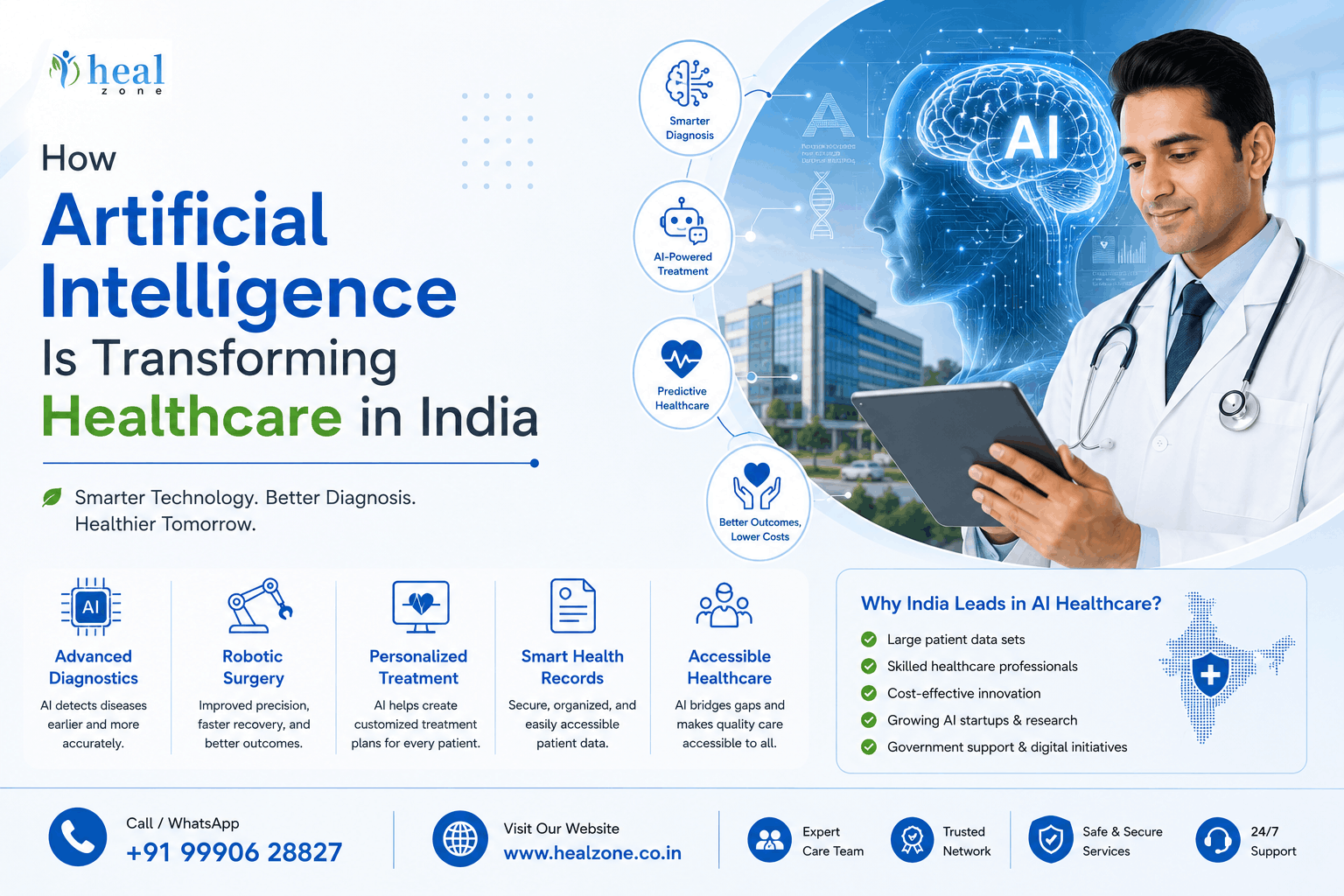
From early disease detection and personalized treatment planning to hospital operations, medical research, and remote patient care, Artificial Intelligence is revolutionizing how healthcare is delivered in India. This article provides an in-depth, EEAT-compliant analysis of how AI is transforming Indian healthcare, its real-world applications, benefits, challenges, ethical considerations, and future potential.
What Is Artificial Intelligence in Healthcare?
Artificial Intelligence in healthcare refers to the use of machine learning (ML), deep learning, natural language processing (NLP), computer vision, and predictive analytics to simulate human intelligence in medical decision-making.
AI systems are capable of:
- Analyzing vast volumes of medical data
- Identifying patterns invisible to the human eye
- Learning continuously from outcomes
- Supporting doctors in clinical decisions
It is important to note that AI does not replace doctors. Instead, it acts as a clinical support system, enhancing accuracy, speed, and efficiency while allowing healthcare professionals to focus more on patient care.
Why AI Is Crucial for India’s Healthcare System
India’s healthcare system faces several structural challenges:
- High patient-to-doctor ratio
- Unequal access to quality healthcare between urban and rural regions
- Rising burden of non-communicable diseases
- Increasing healthcare costs
- Limited infrastructure in remote areas
AI offers scalable solutions to these challenges by:
- Improving diagnostic accuracy
- Enabling remote healthcare delivery
- Reducing operational inefficiencies
- Supporting preventive and predictive care
With strong government backing, a rapidly growing health-tech ecosystem, and increasing digitization, India is uniquely positioned to become a global leader in AI-powered healthcare.
Key Areas Where AI Is Transforming Healthcare in India
AI in Medical Diagnosis and Early Disease Detection
One of the most significant contributions of AI in Indian healthcare is early and accurate diagnosis.
Medical Imaging and Radiology
AI-powered algorithms analyze:
- X-rays
- CT scans
- MRIs
- Mammograms
They can detect conditions such as:
- Breast and lung cancer
- Tuberculosis
- Brain strokes
- Bone fractures and neurological disorders
In many cases, AI detects abnormalities earlier than conventional methods, enabling timely intervention and improved survival rates.
Key benefits:
- Faster diagnosis
- Reduced diagnostic errors
- Support for overburdened radiologists
- Early disease detection
AI in Oncology (Cancer Care)
Cancer treatment in India has seen major advancements through AI integration.
AI assists oncologists in:
- Analyzing pathology slides
- Identifying cancer subtypes
- Predicting tumor behavior
- Selecting personalized treatment plans
- Monitoring treatment response and recurrence risk
By combining clinical data, imaging, and genomics, AI enables precision oncology, reducing overtreatment and improving outcomes—especially critical in complex cancers like leukemia, lymphoma, and solid tumors.
AI in Cardiology and Chronic Disease Management
Cardiovascular diseases, diabetes, and hypertension are leading causes of mortality in India.
AI supports chronic disease management by:
- Interpreting ECGs and imaging reports
- Predicting heart attack or stroke risk
- Monitoring blood glucose trends
- Detecting irregular heart rhythms
AI-powered wearables and remote monitoring tools allow continuous tracking, helping doctors intervene before complications arise.
Outcome:
A shift from reactive treatment to preventive and proactive care.
AI in Pathology and Laboratory Medicine
Traditional pathology is time-intensive and dependent on manual examination. AI-powered digital pathology tools are transforming this field by:
- Automating slide analysis
- Detecting microscopic abnormalities
- Reducing turnaround time
- Improving diagnostic consistency
In India, where laboratories handle massive testing volumes, AI ensures speed without compromising accuracy.
AI-Powered Robotic Surgery
Robotic-assisted surgeries enhanced by AI are becoming increasingly common in Indian hospitals, especially in:
- Urology
- Gynecology
- Oncology
- Orthopedics
AI helps surgeons with:
- Enhanced precision
- Reduced blood loss
- Minimal invasiveness
- Faster recovery times
Patients benefit from shorter hospital stays, fewer complications, and improved surgical outcomes.
AI in Telemedicine and Remote Healthcare
Telemedicine has expanded rapidly in India, and AI has made it more effective and scalable.
AI-driven telehealth platforms offer:
- Automated symptom checkers
- AI chatbots for initial triage
- Smart appointment scheduling
- Language translation support
- Remote follow-ups
This is particularly valuable for:
- Rural populations
- Elderly patients
- International patients seeking continuity of care
AI in Personalized and Predictive Healthcare
AI enables personalized medicine by analyzing:
- Genetic data
- Lifestyle patterns
- Medical history
- Treatment responses
Predictive analytics helps doctors anticipate disease progression, prevent complications, and tailor treatment strategies—moving healthcare from generalized protocols to individualized care plans.
AI in Preventive Healthcare and Lifestyle Medicine
Lifestyle diseases are rising rapidly in India. AI plays a crucial role in prevention by:
- Assessing individual health risks
- Predicting future disease likelihood
- Offering personalized diet, exercise, sleep, and stress-management plans
This preventive approach reduces hospitalizations and long-term healthcare costs while improving quality of life.
AI in Mental Healthcare
Mental health disorders are increasingly prevalent in India, yet access to care remains limited.
AI supports mental healthcare by:
- Early screening for depression and anxiety
- Mood and behavior pattern analysis
- AI chatbots for emotional support
- Remote therapy assistance
AI does not replace mental health professionals but helps bridge access gaps, especially in underserved regions.
AI in Hospital Operations and Administration
AI is transforming backend hospital operations by improving:
- Appointment scheduling
- Bed and ICU management
- Staff allocation
- Billing and insurance processing
- Supply chain optimization
This leads to:
- Reduced waiting times
- Improved patient experience
- Lower operational costs
- Better resource utilization
AI and Health Insurance in India
AI has also reshaped the health insurance ecosystem by:
- Automating claim verification
- Detecting fraudulent claims
- Speeding up settlements
- Enabling risk-based premium models
This improves transparency and reduces financial stress for patients during treatment.
AI in Medical Research and Drug Discovery
AI accelerates medical research by:
- Analyzing molecular data
- Predicting drug effectiveness
- Identifying side effects early
- Reducing development timelines
Indian pharmaceutical and biotech companies increasingly use AI to drive cost-effective innovation.
AI in Public Health and Disease Surveillance
AI supports large-scale public health initiatives by analyzing:
- Disease patterns
- Environmental data
- Population health trends
It helps predict outbreaks, optimize vaccination strategies, and strengthen emergency preparedness—lessons reinforced during the COVID-19 pandemic.
Ethical Considerations of AI in Indian Healthcare
As AI adoption grows, ethical responsibility becomes critical.
Patient Consent and Transparency
Patients must be informed when AI tools are used and how their data is processed.
Bias and Fairness
AI systems must be trained on diverse datasets to avoid healthcare disparities across regions and populations.
Accountability
Clinical responsibility must always remain with healthcare professionals—not machines.
AI Training and Workforce Readiness
For effective adoption, doctors and healthcare staff must be trained to:
- Interpret AI insights
- Understand system limitations
- Integrate AI responsibly into clinical practice
Medical education in India is gradually incorporating digital health and AI literacy modules.
Government Initiatives Supporting AI in Healthcare
The Indian government actively promotes AI adoption through:
- Ayushman Bharat Digital Mission
- National Digital Health Mission
- AI research funding programs
- Support for health-tech startups
These initiatives aim to build a digitally empowered, patient-centric healthcare ecosystem.
AI and Medical Tourism in India
AI strengthens India’s global healthcare appeal by:
- Improving pre-treatment planning
- Enhancing cost transparency
- Enabling remote second opinions
- Supporting post-treatment follow-ups
For international patients, AI ensures trust, efficiency, and continuity of care.
The Future of AI in Healthcare in India
In the coming years, AI will:
- Become integral to clinical decision-making
- Expand preventive and predictive healthcare
- Improve access in rural and remote regions
- Enhance patient outcomes at scale
The future lies in human–AI collaboration, not replacement.
Conclusion
Artificial Intelligence is fundamentally transforming healthcare in India—making it more accurate, accessible, affordable, and patient-centric. From diagnostics and treatment planning to hospital management and public health, AI is empowering doctors while improving outcomes for millions of patients.
As technology evolves and adoption deepens, India is poised to lead the next era of healthcare innovation—where advanced technology meets human expertise and compassion.
Contact us
Written by

B.Sc. & M.Sc. in Medical Imaging Technology
Frequently Asked Questions
Yes, when used under medical supervision and ethical guidelines, AI is safe and highly effective.
No. AI supports doctors but cannot replace human judgment, empathy, and experience.
AI often reduces costs by improving efficiency and preventing complications.
AI improves diagnosis accuracy, treatment planning, communication, and long-term follow-up care.
Latest Blogs
Reviews
I am Fadel Abu Muhammad from Tal Afar, Iraq My father had a brain tumor. We traveled to India to Accord Specialty Hospital, New Delhi, through a resident professor, Muhammad, Dr. Vikram, who called for a laparoscopic tumor removal operation. Thank God I thank the translator, the doctor, and all the hospital staff.
Posted On

I am Muhammad Reda from Baghdad, Iraq I was suffering from weakness in my left hand. I underwent tests and it turned out that I had a brain tumor. The translator, Muqeem Muhammad, contacted us and we traveled to India. I had a neuronavigation procedure performed by Dr. Sandeep Vashya Praise be to God, the operation was completed successfully on the computer At Fortis Hospital New Delhi I thank the translator and the doctor
Posted On
All our gratitude and appreciation to the wonderful translator Mohammed Muqeem, who was truly a great support and companion during our journey for my mother’s treatment in India. He was extremely helpful, deeply understanding of all our needs, patient, and dedicated in his work, which eased a lot of the hardship and challenges we faced being away from home. His presence with us was not just about translating words but about offering real human support in every situation and every moment. May God bless him and reward him greatly for all he has done for us.
Posted On
I'm Emad Mohammed Khadir from Iraq. I was suffering from cirrhosis and liver cancer. I came to Fortis Hospital in India to see Dr. Ankur Bahil, a consultant oncologist, with the help of our translator, resident professor Mohammed Al Hindi. Thank God, we received our chemotherapy doses. The doctor and all the hospital staff were very kind and helpful. May God bless them all. Thank you.
Posted On
I am Redha Fadel from Nasiriyah, Iraq. I had a bone tumor, osteosarcoma. I traveled to India to see Dr. Ankur, a cancer specialist at Fortis Hospital, with the help of Hill Zone Medical Tourism Company, Professor Muqeem Muhammad Al Hindi. I thank you for your humanity and services.
Posted On
Peace be upon you. I am from Iraq. My brother is suffering from a tumor in his left thigh (osteosarcoma). We came to Al-Nahda for treatment. We stayed at Fortis Hospital for two months. We are now going to Iraq and will return to India to complete the treatment and the joint replacement surgery. I would like to thank the polite Indian translator, Muqeem Mohammed Al-Hindi. He was our brother before he was a translator and he helped us a lot with my brother's illness. Thank you, Muqeem. Thank you, Fortis Hospital. Thank you, Dr. Ankur.
Posted On
Peace be upon you, I'm from Iraq. My name is Majid Mazhar Kazim. My brother was suffering from tumors, so we contacted a resident professor, Muhammad Al-Hindi, and we sent him medical reports. He received us from the airport in New Delhi. I highly recommend him to Iraqi patients. He is helpful and well-mannered. He didn't hold back on us and didn't leave us alone from the first day until the last. He also took us to the airport. I thank them all.
Posted On
I am Mohammed Kazim from Iraq, from Babylon. My brother Mushtaq was suffering from meningitis. We came to India to Fortis Hospital through our resident professor, Mohammed, the director of Hill Zone Medical Services. I thank them for their kind treatment and translation. It was an enjoyable and fruitful trip. Praise be to God.
Posted On
I am from iraq tilafar, i came to India for my treatment an immune disease, i am thankful to Mr Muqeem and hospital staff, Marego Asia Hospital
Posted On
I am from Iraq. My son was suffering from Hirayama disease. I called Heal Zone, and they arranged our treatment journey. Now my son is in good health, and his finger movement has come back.
Posted On
