

Contact us
- Why Blood Cancer Remains a Major Global Health Challenge
- Common symptoms seen in blood cancer patients include:
- What Exactly Is CAR-T Cell Therapy?
- Why CAR-T Therapy Is Called Living Medicine
- Detailed Step-by-Step Process of CAR-T Cell Therapy
- Which Blood Cancers Benefit Most from CAR-T Therapy?
- Why CAR-T Therapy Is Transforming Blood Cancer Treatment Globally
- How CAR-T Differs from Stem Cell Transplant
- Side Effects of CAR-T Therapy: Why Expert Monitoring Matters
- Why India Is Emerging as an Important Destination for CAR-T Therapy
- How Healzone Supports International Patients Seeking Advanced Blood Cancer Treatment
- Challenges Still Being Solved in CAR-T Therapy
- Can CAR-T Therapy Replace Chemotherapy Completely?
- Who Should Ask a Specialist About CAR-T Therapy?
- The Future of Blood Cancer Care
- Final Perspective
The treatment of blood cancer has entered a new era. For many years, patients diagnosed with serious blood-related malignancies such as leukemia, lymphoma, and multiple myeloma depended mainly on chemotherapy, radiation therapy, targeted drugs, and stem cell transplantation. These treatments remain highly important and continue to save countless lives, but they also have limitations—especially when the disease becomes resistant, returns after remission, or stops responding to conventional therapy.
In recent years, one treatment has transformed global oncology discussions because of its ability to produce remarkable responses even in difficult cases: CAR-T Cell Therapy.
This highly advanced treatment is often described as one of the most important breakthroughs in modern cancer medicine because it uses the patient’s own immune system as a living drug. Rather than attacking cancer only through medicines, CAR-T therapy re-engineers immune cells so they can identify and destroy cancer cells more effectively.
For many blood cancer patients who previously had very few treatment options left, CAR-T Cell Therapy has opened a new path of hope.
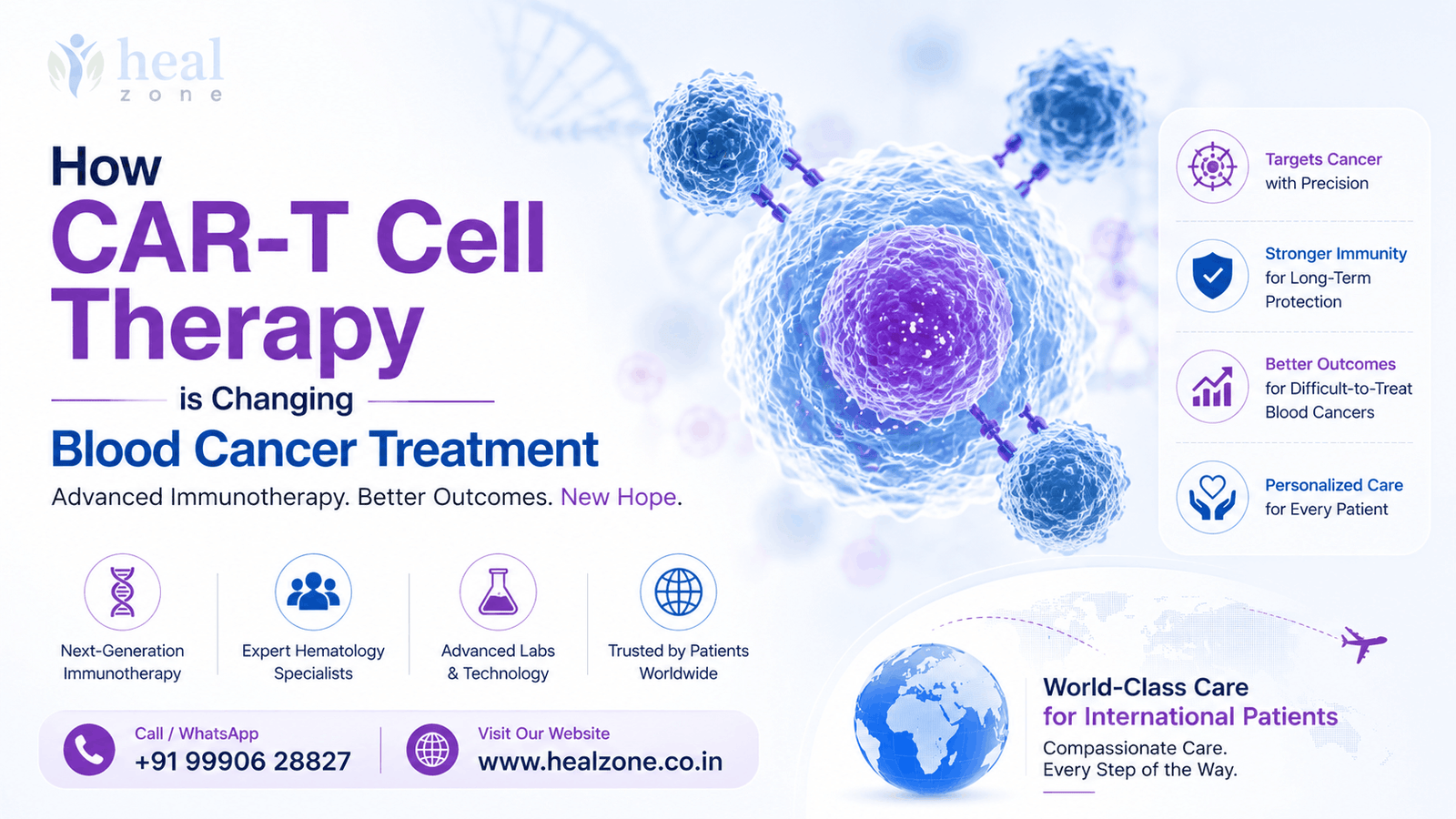
Why Blood Cancer Remains a Major Global Health Challenge
Blood cancers are different from solid tumors because they directly affect the blood-forming tissues, immune system, and bone marrow. This means the disease often spreads throughout the body rather than remaining confined to one location.
The main types of blood cancer include:
- Leukemia
- Lymphoma
- Multiple Myeloma
These cancers disrupt normal blood cell production and weaken the body's natural defense mechanisms.
Because blood cells are essential for oxygen transport, immunity, and clotting, the disease can rapidly affect overall health.
Common symptoms seen in blood cancer patients include:
- Persistent weakness and fatigue
- Frequent infections
- Fever without clear cause
- Swollen lymph nodes
- Night sweats
- Bone pain
- Easy bruising
- Unexplained bleeding
- Weight loss
- Reduced immunity
In many patients, standard treatment works well initially. However, relapse remains a major concern, especially in aggressive blood cancers.
This is where advanced immunotherapy has changed treatment strategy.
What Exactly Is CAR-T Cell Therapy?
CAR-T stands for Chimeric Antigen Receptor T-cell Therapy.
It is a personalized immunotherapy where doctors collect the patient’s own immune cells—specifically T-cells—and genetically modify them in a laboratory so they can recognize and attack cancer cells.
T-cells normally protect the body against infections and abnormal cells. However, cancer cells often develop ways to escape immune detection.
CAR-T therapy solves this problem by adding a special receptor to T-cells that helps them identify cancer more precisely.
This receptor acts like a highly specialized detection system.
Once returned to the body, these modified cells actively search for cancer cells and destroy them.
Why CAR-T Therapy Is Called Living Medicine
Unlike traditional drugs that are administered and metabolized, CAR-T cells remain biologically active inside the body.
They continue multiplying and fighting cancer after infusion.
This is why many experts call CAR-T a living treatment rather than a conventional drug.
It represents a completely different philosophy of cancer therapy: instead of giving chemicals repeatedly, doctors train the body’s own immune system to become stronger than the disease.
Detailed Step-by-Step Process of CAR-T Cell Therapy
Step 1: Patient Evaluation and Eligibility Assessment
Not every blood cancer patient immediately qualifies for CAR-T therapy.
Specialists first evaluate:
- Type of blood cancer
- Disease stage
- Previous treatments
- Bone marrow function
- Organ health
- Infection status
- Overall physical condition
This detailed evaluation is critical because CAR-T therapy requires careful planning.
Step 2: Collection of Immune Cells (Leukapheresis)
T-cells are collected from the patient’s blood through leukapheresis.
This process separates white blood cells while returning remaining blood components back into circulation.
The procedure usually takes several hours and is generally safe.
Step 3: Genetic Engineering in Advanced Laboratory
The collected T-cells are sent to a highly specialized laboratory.
Scientists then insert a synthetic receptor called a Chimeric Antigen Receptor (CAR).
This receptor helps immune cells identify cancer proteins such as CD19 or BCMA, depending on the cancer type.
This genetic modification transforms ordinary T-cells into highly targeted anti-cancer cells.
Step 4: Expansion of Modified Cells
The modified cells are multiplied into millions of copies.
This ensures that enough active cells are available to create a strong anti-cancer effect after infusion.
Step 5: Conditioning Chemotherapy Before Infusion
Before CAR-T infusion, doctors usually administer low-dose chemotherapy.
This is not intended to kill cancer aggressively but to prepare the immune environment so CAR-T cells can expand better.
Step 6: Infusion of CAR-T Cells into the Body
The engineered cells are infused through intravenous administration.
This step may appear simple, but what follows inside the body is highly sophisticated immune activation.
The cells begin circulating, identifying cancer cells, and initiating destruction.
Step 7: Close Monitoring After Infusion
Because immune activation can be intense, patients require strict monitoring for several days to weeks.
Specialist teams watch for side effects and early response signs.
Which Blood Cancers Benefit Most from CAR-T Therapy?
Acute Lymphoblastic Leukemia
This has shown some of the strongest responses, especially in relapsed pediatric and young adult patients.
Diffuse Large B-Cell Lymphoma
One of the most aggressive lymphomas where CAR-T has changed outcomes significantly.
Multiple Myeloma
Patients who fail several treatment lines often show major benefit.
Mantle Cell Lymphoma
This difficult subtype now has highly promising CAR-T outcomes.
Follicular Lymphoma
Certain advanced cases may qualify.
Why CAR-T Therapy Is Transforming Blood Cancer Treatment Globally
It Works When Other Treatments Fail
One of the most powerful aspects of CAR-T therapy is that many patients receiving it have already failed multiple prior therapies.
This includes:
- Multiple chemotherapy cycles
- Stem cell transplant
- Targeted therapy
- Immunotherapy
Yet CAR-T still produces meaningful remission in many cases.
It Creates Deep Cancer Responses
In several patients, measurable cancer burden drops dramatically after infusion.
This depth of response is often stronger than expected in heavily pretreated disease.
It Offers Long-Term Immune Surveillance
Some modified T-cells remain active for long periods.
This means they may continue controlling disease even after initial remission.
It Reduces Dependence on Repeated Treatment Cycles
Unlike chemotherapy, which often requires repeated cycles, CAR-T may work after a single infusion.
How CAR-T Differs from Stem Cell Transplant
Patients often confuse CAR-T therapy with stem cell transplant, but both are different.
Stem Cell Transplant
- Replaces damaged bone marrow
- Requires donor or self stem cells
- Focuses on marrow recovery
CAR-T Therapy
- Uses immune cells
- Focuses on active cancer destruction
- Does not replace marrow
In some cases, CAR-T is considered after transplant failure.
Side Effects of CAR-T Therapy: Why Expert Monitoring Matters
Although revolutionary, CAR-T therapy is medically complex.
Cytokine Release Syndrome (CRS)
This occurs when immune activation becomes intense.
Symptoms include:
- Fever
- Low blood pressure
- Breathing difficulty
- Rapid heart rate
Neurological Toxicity
Some patients may temporarily develop:
- Confusion
- Difficulty speaking
- Headache
- Tremors
Temporary Bone Marrow Suppression
Blood counts may remain low for some time.
This requires infection prevention and specialist supervision.
Why India Is Emerging as an Important Destination for CAR-T Therapy
India has rapidly developed advanced hematology and oncology infrastructure.
Many international patients now explore treatment in India because of:
- Advanced cancer centers
- Experienced hematologists
- Modern cellular therapy facilities
- Lower treatment cost compared to many Western countries
- International patient support systems
For medical travelers, this combination is highly attractive.
How Healzone Supports International Patients Seeking Advanced Blood Cancer Treatment
For international patients exploring advanced therapies such as CAR T-cell therapy, treatment planning often involves much more than selecting a hospital. Patients and families frequently need guidance in understanding available treatment options, identifying the right hematology specialist, comparing hospitals, arranging medical documents, planning travel, and managing treatment timelines in a foreign country.
This is where Healzone plays an important supportive role by helping international patients connect with leading cancer specialists and advanced treatment centers in India. The platform assists patients throughout the treatment journey by simplifying hospital coordination, medical opinion sharing, appointment scheduling, and pre-treatment communication with expert doctors.
In addition to medical coordination, Healzone also supports international patients with services such as:
- Doctor consultation planning
- Medical visa guidance
- Hospital selection support
- Cost estimation assistance
- Airport pickup coordination
- Accommodation support for patients and attendants
- Language and travel assistance when required
Because advanced blood cancer treatments such as CAR-T therapy often require careful timing, laboratory preparation, and specialist monitoring, having structured coordination becomes extremely valuable for families traveling from abroad.
India has emerged as an important destination for advanced hematology care because it combines experienced specialists, modern treatment infrastructure, and comparatively affordable medical care. Through trusted treatment coordination, Healzone helps patients access these facilities in a more organized and informed way.
For patients facing relapsed leukemia, lymphoma, or multiple myeloma, early expert evaluation is essential—and timely guidance can often make the treatment journey smoother and less stressful.
Challenges Still Being Solved in CAR-T Therapy
Despite major success, scientists continue improving:
- Faster manufacturing time
- Lower toxicity
- Better affordability
- More targets for different cancers
- CAR-T for solid tumors
The future of cancer treatment may increasingly depend on cellular engineering.
Can CAR-T Therapy Replace Chemotherapy Completely?
At present, no.
Chemotherapy still remains important.
But CAR-T is changing where treatment begins and how relapse is managed.
In future, treatment combinations may become even more personalized.
Who Should Ask a Specialist About CAR-T Therapy?
Patients should discuss CAR-T if they have:
- Relapsed leukemia
- Resistant lymphoma
- Refractory multiple myeloma
- Limited response after transplant
- Repeated recurrence after targeted therapy
Early referral often improves treatment planning.
The Future of Blood Cancer Care
CAR-T therapy represents a major shift in oncology because it proves that cancer can be fought by reprogramming the immune system itself.
This is not simply a new drug.
It is a new treatment philosophy.
As research expands, newer generations of CAR-T may become:
- Safer
- Faster
- More affordable
- Effective for more cancers
The coming years may redefine blood cancer survival worldwide.
Final Perspective
For blood cancer patients facing relapse or limited options, CAR-T Cell Therapy has become one of the most important medical advances available today.
Its ability to convert a patient’s own immune cells into active cancer fighters has changed what doctors can offer in difficult cases.
While it requires specialist centers and expert monitoring, its impact on leukemia, lymphoma, and myeloma treatment continues to grow rapidly across the world.
For many families, CAR-T therapy is no longer experimental hope—it is now a real treatment option that is actively changing survival possibilities.
Contact us
Written by

B.Sc. & M.Sc. in Medical Imaging Technology



Dr. Dharma Choudhary
MBBS, MD, DM
Bone Marrow Transplant Specialist, Hemato-Oncologist, Hematologist
20 Years Years of Experience
Dr. Rahul Bhargava
MBBS, MD, DM
Bone Marrow Transplant Specialist, Hemato-Oncologist, Hematologist
22 Years Years of Experience
Latest Blogs
Reviews
I am Fadel Abu Muhammad from Tal Afar, Iraq My father had a brain tumor. We traveled to India to Accord Specialty Hospital, New Delhi, through a resident professor, Muhammad, Dr. Vikram, who called for a laparoscopic tumor removal operation. Thank God I thank the translator, the doctor, and all the hospital staff.
Posted On

I am Muhammad Reda from Baghdad, Iraq I was suffering from weakness in my left hand. I underwent tests and it turned out that I had a brain tumor. The translator, Muqeem Muhammad, contacted us and we traveled to India. I had a neuronavigation procedure performed by Dr. Sandeep Vashya Praise be to God, the operation was completed successfully on the computer At Fortis Hospital New Delhi I thank the translator and the doctor
Posted On
All our gratitude and appreciation to the wonderful translator Mohammed Muqeem, who was truly a great support and companion during our journey for my mother’s treatment in India. He was extremely helpful, deeply understanding of all our needs, patient, and dedicated in his work, which eased a lot of the hardship and challenges we faced being away from home. His presence with us was not just about translating words but about offering real human support in every situation and every moment. May God bless him and reward him greatly for all he has done for us.
Posted On
I'm Emad Mohammed Khadir from Iraq. I was suffering from cirrhosis and liver cancer. I came to Fortis Hospital in India to see Dr. Ankur Bahil, a consultant oncologist, with the help of our translator, resident professor Mohammed Al Hindi. Thank God, we received our chemotherapy doses. The doctor and all the hospital staff were very kind and helpful. May God bless them all. Thank you.
Posted On
I am Redha Fadel from Nasiriyah, Iraq. I had a bone tumor, osteosarcoma. I traveled to India to see Dr. Ankur, a cancer specialist at Fortis Hospital, with the help of Hill Zone Medical Tourism Company, Professor Muqeem Muhammad Al Hindi. I thank you for your humanity and services.
Posted On
Peace be upon you. I am from Iraq. My brother is suffering from a tumor in his left thigh (osteosarcoma). We came to Al-Nahda for treatment. We stayed at Fortis Hospital for two months. We are now going to Iraq and will return to India to complete the treatment and the joint replacement surgery. I would like to thank the polite Indian translator, Muqeem Mohammed Al-Hindi. He was our brother before he was a translator and he helped us a lot with my brother's illness. Thank you, Muqeem. Thank you, Fortis Hospital. Thank you, Dr. Ankur.
Posted On
Peace be upon you, I'm from Iraq. My name is Majid Mazhar Kazim. My brother was suffering from tumors, so we contacted a resident professor, Muhammad Al-Hindi, and we sent him medical reports. He received us from the airport in New Delhi. I highly recommend him to Iraqi patients. He is helpful and well-mannered. He didn't hold back on us and didn't leave us alone from the first day until the last. He also took us to the airport. I thank them all.
Posted On
I am Mohammed Kazim from Iraq, from Babylon. My brother Mushtaq was suffering from meningitis. We came to India to Fortis Hospital through our resident professor, Mohammed, the director of Hill Zone Medical Services. I thank them for their kind treatment and translation. It was an enjoyable and fruitful trip. Praise be to God.
Posted On
I am from iraq tilafar, i came to India for my treatment an immune disease, i am thankful to Mr Muqeem and hospital staff, Marego Asia Hospital
Posted On
I am from Iraq. My son was suffering from Hirayama disease. I called Heal Zone, and they arranged our treatment journey. Now my son is in good health, and his finger movement has come back.
Posted On
