

MR Linac Radiation Therapy Cost in India
Contact us for MR Linac Radiation Therapy Cost in India

$ 11,000 - $ 14,000
2-3 weeks
What is an MR-Linac?
An MR-Linac (MRI-guided Linear Accelerator) combines a high-field MRI scanner with a radiation delivery system in a single device. While the linear accelerator administers the dose, the MRI continuously displays soft-tissue anatomy in real time. Clinicians can then re-optimize the plan at the treatment table and pause or resume the beam if the target or nearby organs shift due to breathing, bladder or rectal filling, or gut motion. This process is commonly known as MR-guided adaptive radiotherapy (MRgRT).
Commercial platforms, such as systems combining a 1.5T MRI with a linac, are built for daily plan adjustment, motion tracking, and accurate dosing. They are particularly useful when soft tissues shift or are close to organs at risk.
Why MR-Linac matters: Key clinical advantages
- Real-time MRI visualization: Shows soft tissues with much greater contrast than CT or X-ray imaging, helping clinicians clearly distinguish the tumor from organs at risk in areas like the pancreas, liver, rectum, and prostate.
- On-table plan adaptation: If the anatomy on the day of treatment differs from the original plan, the team can re-contour and re-optimize before delivering the dose, enhancing accuracy and allowing safe dose escalation when needed.
- Motion management: Respiratory motion and peristalsis can be controlled with gating or tracking, which reduces treatment margins and decreases dose to healthy tissue.
- Potentially fewer visits: In certain conditions, the combination of precision and confidence in daily anatomy supports ultra-hypofractionation—fewer, larger fractions—without compromising safety parameters.
Top Doctors for MR-Linac Radiation Therapy in India


Indications: When do doctors consider MR-Linac?
Your multidisciplinary tumour board decides final suitability, but MR-Linac is frequently considered for:
- Prostate cancer (localized or oligometastatic), where prostate, bladder, and rectum motion complicates targeting.
- Pancreatic cancer (borderline resectable or locally advanced), where tumours sit near radiosensitive bowel.
- Liver tumours (HCC or metastases), particularly lesions influenced by breathing motion.
- Early lung lesions and oligometastatic disease, when precise ablative dosing is planned.
- Rectal cancer, select head & neck cases, brain tumours/benign lesions, and some re-irradiation scenarios where prior dose limits options.
Not everyone needs MR-Linac. Many patients do excellently with IMRT/IGRT, VMAT, SBRT, or proton therapy.The decision depends on anatomy, movement, proximity to critical structures, treatment goals, and cost.
MR-Linac vs other radiotherapy techniques
| Modality | What it is | Strengths | Typical use cases |
|---|---|---|---|
| IMRT/IGRT/VMAT | X-ray guided linacs with kV/MV or CBCT imaging | Widely available, efficient, cost-effective | Most common solid tumours |
| SBRT/SRS | High, ablative dose in few sessions, CT/CBCT guidance | Short course, very conformal dosing | Small lung/liver/spine/brain lesions |
| MR-Linac (MRgRT) | Real-time MRI + linac with daily adaptation | Best soft-tissue visualization, motion gating, margin reduction | Pancreas, liver, prostate, rectum, mobile lung targets, re-irradiation |
| Proton therapy | Proton beam with pronounced Bragg peak | Minimal exit dose, excellent OAR sparing | Paediatrics, skull-base, select head & neck; limited availability |
MR-Linac Radiation Therapy Cost in India (2025)
Quick view: For international, self-pay patients, a full MR-Linac course in India typically costs USD 12,000–15,000. The exact quote depends on the disease site, fractionation (e.g., five vs 15–25 sessions), planning complexity, and city.
For context, “radiation therapy” as a broader category in India spans roughly INR 30,000 to INR 20,00,000, depending on the technique (from basic 2D to IMRT/IGRT/SBRT/MRgRT), the number of fractions, and the hospital tier.
What typically goes into an MR-Linac package?
- Specialist consultations and treatment planning
- Simulation with MRI/CT and immobilization
- Adaptive planning time at each fraction (physicist and radiation oncologist effort)
- Treatment delivery with real-time MRI guidance/gating
- On-treatment reviews and supportive medications
- Follow-up consults and, if applicable, response imaging
Why the premium over standard IMRT/IGRT?
MR-Linac involves high-end hardware (MRI + linac), specialized room design, longer appointment slots due to on-table replanning, and a larger, more specialized team present during each fraction.
Top Hospitals for MR-Linac Radiation Therapy in India
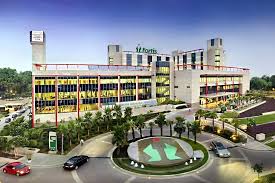
Fortis Memorial Research Institute
Sector - 44, Opposite HUDA City Centre, Gurugram, Haryana 122002
Cost comparison: MR-Linac vs other options in India
Numbers vary across cities and hospital brands. Always request a written, itemized quote.
- IMRT/IGRT/VMAT (full course): ~INR 1,00,000–4,00,000 in many private centres (ranges can be wider in metros).
- SBRT/SRS (per session): ~INR 1,50,000–5,00,000; total cost depends on 1–5 fractions.
- MR-Linac (MRgRT): ~USD 12,000–15,000 for a complete course (≈ INR 10–13 lakh).
- Proton therapy: often INR 20,00,000–25,00,000 per course; availability remains limited.
Tip: Clarify whether pricing is per fraction or all-inclusive. Ask if the quote covers planning scans, adaptive time, image guidance, inpatient days (if any), blood tests, and follow-ups.
Who benefits most from MR-Linac?
- Soft-tissue tumours where CT contrast is limited (prostate, rectum, pancreas, many liver lesions).
- Mobile targets impacted by breathing or organ filling—where gating and on-table adaptation shrink margins.
- Re-irradiation cases, where precise sparing of previously dosed organs is crucial.
- Ultra-hypofractionation candidates (for instance, selected prostate cases) seeking a shorter course with high confidence in daily anatomy.
Who may not need it?
When the target is large but relatively fixed, well-seen on CT/CBCT, and constraints are comfortably met with standard IGRT/SBRT, a conventional technique may be the most cost-effective option.
Which hospitals have MR-Linac in India?
Availability is expanding. Confirm the exact model on site and the current operational status before you travel.
- Yashoda Hospitals, Hyderabad — early national adopter with a comprehensive MR-guided program.
- Fortis Memorial Research Institute (FMRI), Gurugram — among North India’s pioneers.
- HCG (Healthcare Global) — network announcements include MR-Linac; confirm location-wise commissioning.
Major oncology networks (Apollo, Medanta, Max, Aster, Manipal, etc.) operate advanced linear accelerators for IMRT/IGRT/VMAT/SBRT; if you specifically want MR-Linac, ask for the machine name and commissioning date at the chosen site.
Your MR-Linac treatment journey in India: Step by step
-
Remote triage & eligibility
Share recent imaging (MRI/CT/PET-CT), biopsy results, and any previous radiotherapy details. The team advises on suitability and a likely fractionation schedule. -
Arrival & work-up
Medical fitness checks, MR-safety screening, and planning MRI/CT in treatment position. Immobilization devices may be fabricated at this stage. -
Planning
Target and organ-at-risk contours are created; a preliminary plan is generated and reviewed. -
Daily adaptive sessions
- Pre-treatment MRI each day.
- If anatomy differs, the team re-contours and re-optimizes the plan on the table.
- Gating/tracking pauses dose if the target drifts.
- On-table quality checks and physician approval, then treatment delivery.
-
On-treatment reviews
Weekly assessments manage symptoms and confirm tolerance. -
Follow-up
Imaging and clinic reviews typically occur several weeks after completing therapy, then at scheduled intervals.
Typical time in India:
- Ultrahypofractionated courses (e.g., 5 fractions): ~10–14 days end-to-end.
- Conventional fractionation or intermediate schedules: ~3–5 weeks.
Outcomes, side effects, and recovery
- Effectiveness
MR-Linac improves geometric precision rather than changing the type of radiation. The ability to see anatomy and adapt daily can permit safer dose escalation and better protection of nearby organs, particularly in challenging sites like pancreas and liver. - Tolerability
By shrinking margins and using gating, many patients—especially in prostate treatments—report fewer urinary or rectal irritative symptoms compared with non-MRI-guided workflows (individual results vary). - Recovery
Most sessions are outpatient. Common short-term effects include fatigue and site-specific irritation; many people resume normal activities the same day.
What drives the cost? (Why quotes differ)
- City and hospital brand: Major metros and flagship hospitals generally price higher.
- Planning complexity: Multi-target lesions, tight organ constraints, or re-irradiation require more contouring and physics time.
- Number of fractions: Ultrafew fractions mean fewer visits, but each session involves intensive on-table adaptation.
- Technology & support: MRI-linac systems are premium capital equipment with advanced software and service contracts; room siting and maintenance add to overhead.
- Add-ons: PET-CTs, contrast MRIs, fiducial/spacer procedures, anesthesia for claustrophobia, or inpatient observation can affect the final bill.
Budgeting for international patients:
- MR-Linac package: USD 12,000–15,000 (typical private-sector range).
- Pre-treatment tests: USD 300–1,000 (varies by recency/availability of your prior scans).
- Accommodation & local transport: plan for 2–4 weeks near the treating centre if multiple fractions are scheduled.
- Companion & visa costs: medical visa fees, travel insurance, and attendant expenses.
Ask for a written, all-inclusive proposal that specifies:planning scans, per-fraction adaptation charges, image guidance, consultations, consumables, any inpatient days, and follow-up visits.
India vs overseas: The big difference
For self-pay patients, India’s MR-Linac programs generally cost a fraction of Western cash-pay rates while using the same global-standard platforms and protocols. The gap is driven more by labour and overhead than by technology differences.
Choosing between MR-Linac and alternatives
Favour MR-Linac if:
- The tumour moves or abuts radiosensitive organs: e.g., pancreas near duodenum; liver dome near diaphragm.
- You need re-irradiation: with strict organ sparing.
- Your team plans ultra-hypofractionation: wants the highest certainty about daily anatomy.
Standard IMRT/IGRT/VMAT or SBRT may suffice if:
- The target is stable: clearly seen on CT/CBCT, and OAR limits are comfortably met.
- Cost or access is a major constraint.
Consider proton therapy if:
- You’re a paediatric patient, have skull-base tumours, or scenarios where minimizing exit dose is paramount: and a proton centre is accessible.
Spotlight on Indian centres
Yashoda Hospitals, Hyderabad:
Among the first in India to commission MR-Linac, with active programs for prostate and other soft-tissue sites and a patient education focus on MRI-guided precision.
Fortis Memorial Research Institute (FMRI), Gurugram:
A North India leader in MR-guided radiotherapy; published updates describe broadening indications and increasing patient volumes.
Always verify the machine model, commissioning date, and current case volumes when selecting a centre.
What records should I share to get a quick MR-Linac opinion?
For a treatment quotation, share with us details below:
- Histopathology/biopsy report
- Recent imaging (MRI/CT/PET-CT; ideally within 6–8 weeks)
- Any previous radiotherapy records (including dose-volume histograms)
- List of co-morbidities, medications, and any implants (for MRI safety screening)
Safety notes and MRI-specific considerations
- MRI safety screening is mandatory. Some pacemakers, cochlear implants, aneurysm clips, or older metallic implants may be incompatible.
- Claustrophobia can often be managed with coaching or mild medication as needed.
- Side effects depend on site and dose; MR-Linac’s tighter margins aim to reduce exposure to nearby organs.
How HealZone Supports your treatment trip
- Rapid pre-assessment from two or more NABH/JCI-accredited centres (MR-Linac vs alternatives).
- Transparent, itemized quotes (planning, per-fraction, imaging, follow-ups).
- Travel facilitation — invitation letter, airport pickup, nearby hotel options, interpreter support.
- On-ground coordination — daily case updates, pharmacy and physiotherapy tie-ins.
- Post-treatment follow-up — teleconsults and reminders for surveillance scans.
Key takeaways about MR-Linac in India
- MR-Linac (MRgRT) fuses MRI with a linear accelerator to enable real-time imaging, motion management, and day-to-day adaptive planning.
- It’s especially valuable for mobile soft-tissue tumours (prostate, pancreas, liver, rectum) and re-irradiation.
- Cost in India: budget USD 12,000–15,000 for a complete MR-guided course; conventional IMRT/IGRT often costs considerably less.
- Availability: limited to select high-end centres; verify machine model and operational status before you book.
How can I get a personalized MR-Linac cost estimate?
Share your latest reports, a preferred city, and tentative travel dates. I’ll prepare center-specific MR-Linac quotes (plus a side-by-side IMRT/IGRT/SBRT comparison), including timelines, total costs, and expected stays, so you can plan confidently.
Note: This content is for patient education and travel planning. It does not replace a consultation with a qualified radiation oncologist, who will advise on suitability and exact protocols for your case.
